Howell Edmunds Jackson Quotes
… the most disastrous blow ever struck at the constitutional power of Congress
This was the case where the Supreme Court reversed its earlier opinion and declared the Income Tax Unconstitutional.
Howell Edmunds Jackson, 1832-1895, U. S. Supreme Court Justice, U. S. Congressman (Democrat, TN), Dissent, Pollack v. Farmers’ Loan and Trust Co., criticizing the majority opinion,1895
Sourced by: Eigen's Political and Historical Quotations


In 1949 the NATO treaty was signed. There was concern that a phrase in the treaty authorizing signatories to take "such action as it deems necessary, including the use of armed force" would undermine Congress's powers:


This notion seems to have first been expressed by Edward S. Corwin in 1940


Marshall is famous for, as Chief Justice, establishing the principle that the Judiciary can override Congress and the Executive in determining Constitutionality. However, as this quotation illustrates this principle had been discussed in open debate on the ratification of the Constitution. It was not simply a grab for power by a Chief justice; he uttered this quotation long before he ever suspected he would be a judge but actually spent much of his career in the executive and legislative branch of government.

Barstow the Democratic Governor who had no serious opposition in 1853 found himself challenged for reelection by Coles Bashford of the new Republican Party. The Board of Canvassers reported that Governor Barstow had won reelection but by less than 200 votes in the whole state. The Republicans charged that there had been fraud in some of the rural districts and petitioned the Wisconsin Supreme Court which ruled that nonexistent precincts had indeed voted for the Governor. The Barstow however refused to recognize the decisions of the court claiming that the court had no jurisdiction over the Board of Canvassers who were part of the executive branch. The Republicans held their own inauguration and two men claimed to be Governor. But the Governor claimed that the state constitution did not give the court any authority to deal with the crisis, He even called out the State Militia to maintain his office and intimidate the Supreme Court and keep the “other governor” from the state house. Nonetheless the court ruled that even the Governor had to obey the law and the Supreme Court would determine what the law was. Barstow finally “resigned.” See {587917} & {587914}.


President Abraham Lincoln had pocket vetoed his own party's reconstruction bill in the midst of an election year.


The view that the Supreme Court was the final arbiter of constitutional controversies was not held in early America.


The Congress over the last century has ceded much of its Constitutional power to the President. Congress has much power to check the President, but just as Congress has not been very competent at legislating, oversight, and conducting hearings and investigations, it has not organized itself to use the powers it has very well.

In the English system the checks and balances of the American system are not present. Historically in England the Monarch and the Parliament acted as checks upon each other. With a Constitutional Monarch there is no institutional check on Parliament. The checks are their restraint--respect for precedent--and the voters. The Prime Minister is a member of Parliament and has no powers other than what Parliament gives him/her. The courts in England are under Parliament and the upper house, the House of Lords is the equivalent of the highest court—but it may always be overruled by the parliament itself.

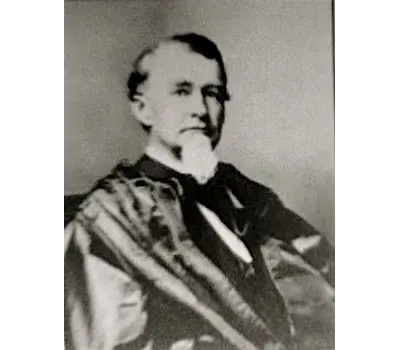
Howell Edmunds Jackson was an American attorney, politician, and jurist. He served as an Associate Justice of the Supreme Court of the United States, as a United States Senator from Tennessee and as a United States Circuit Judge of the United States Court of Appeals for the Sixth Circuit and the United States Circuit Courts for the Sixth Circuit. Jackson was the first to bring a law school graduate with him to serve as his secretary-clerk on the Supreme Court; that secretary-clerk was James Clark McReynolds, who would later also became a Supreme Court Justice.
