Charles I Quotes
Not a moment longer!
Charles I, 1600-1649, King of Great Britain & Ireland, Statement made as he dissolved Parliament, June 1626
Sourced by: Eigen's Political and Historical Quotations


Milosevic had been rejected at the polls, but the question was whether of not he would give up power. He finally did.

The King's staff had threatened Parliament before. See Dudley Carleton.


Ataturk wanted to change the Turkish alphabet from Arabic to Latin characters. Experts estimated that it would take at least 15 years. Ataturk allowed no parallel usage, made it illegal for any documents or signs to be written in Arabic, and it was done in 3 months. The benefit was that Arabic took much longer to learn. Relatively few people could read or write. Arabic had been imposed on the Turkish language. Printing with movable type was much more difficult in Arabic and Atatuk wanted many more books published and read. Soon Turkey had the highest literacy rate in the Islamic world, and rivaled that of most Western nations. Making the sudden change not only had the advantage of fixating the entire society on the change, but did not allow opponents of the change (of which there were many) —especially the Islamic clergy many of whom felt that the Koran was the only book that people should be allowed to read.

Referring to William E. Gladstone, 1809-1898, British Prime Minister

In 1628 Parliament, in response to abuses by King Charles I, was about to pass The Petition of Rights–-a type of Bill of Rights. The King gave assurances that the practices—such as forcing nobles to lend him money—would not continue and didn't want to be embarrassed by passage of a law which he claimed would indicate that the Parliament did not trust him and weaken the dignity of the monarchy. The Petition of Rights passed with Cole’s leadership.

money for the king's government In 1628 there was a classic English struggle between the king, Charles I, and Parliament. While Parliament was sitting, Dr. Manwaring, an Anglican Bishop, preached a sermon. He claimed that God intended all private property to be at the disposal of the King in times of national emergency. Further, that the King could levy an taxes without the consent of Parliament. The King liked the sermon so much that he had it printed and distributed by special command. The House of Commons went bonkers and impeached Manwaring. He was imprisoned by order of the House, fined the then huge sum of 1,000 pounds, and prohibited from holding any ecclesiastical or secular office in the future. As soon as the session of Parliament ended, the king pardoned him, gave him a huge salary raise, and several years later Manwaring was appointed Bishop of Asaph. King Charles I, perhaps England’s worst sovereign, then provoked two civil wars and was finally tried for treason and beheaded. Manwaring was in and out of prison during the conflicts. He faded from public view.

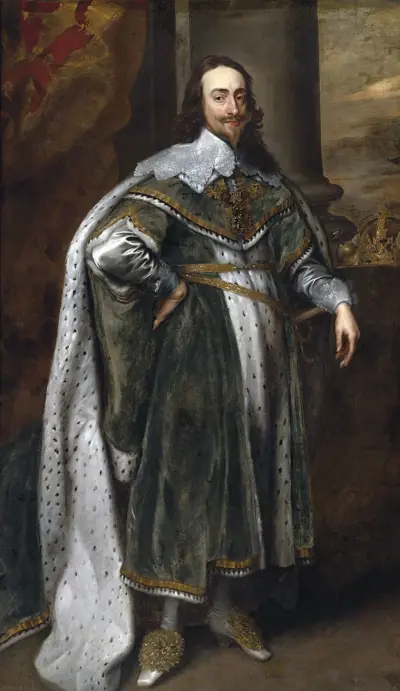
Charles I was King of England, Scotland, and Ireland from 27 March 1625 until his execution in 1649. He was born into the House of Stuart as the second son of King James VI of Scotland, but after his father inherited the English throne in 1603 (as James I), he moved to England, where he spent much of the rest of his life. He became heir apparent to the three kingdoms of England, Scotland, and Ireland in 1612 on the death of his elder brother Henry Frederick, Prince of Wales. An unsuccessful and unpopular attempt to marry him to the Spanish Habsburg princess Maria Anna culminated in an eight-month visit to Spain in 1623 that demonstrated the futility of the marriage negotiations. Two years later, he married the Bourbon princess Henrietta Maria of France.
