Donald Rumsfeld Quotes
When cutting staff at the Pentagon, don't eliminate the thin layer that assures civilian control.
Rumsfeld, Donald. Rumsfeld's Rules: Leadership Lessons in Business, Politics, War, and Life. Broadside Books, 2013.

The irony is that it is just for the lack of this fundamental principle that Napoleon eventually became the Government and the Military in France.


Washington, though a military officer at the time, was very concerned with protecting the rights of citizens from abuse by the military for he had seen much of the abuse. The third amendment for example was later written to protect people from the military. The Constitution also requires that Congress make such rules for the military. Note that Washington, our first senior military officer at the time, wanted Congress to make detailed rules for the conduct of soldiers. In the 20th and 21st century, as the imperial presidency developed, there was a political view that only the military officers and the Commander in Chief should make the rules and regulations for the soldiers. However, there was no question but that the Founding Fathers saw this as a legislative branch function. Congress and Presidents have contested for this power every since.


His statement was on the issuance of Executive Order 9981 which outlawed military segregation and granted equal treatment and opportunity to all service members regardless of their race:


Civilian control of the Military did not just pop in to the Constitution 11 years later. This and many other fundamental ideas had come from the State Constitutions and other documents.

This quotation was an attack on President George W. Bush who had argued to a nation hostile about the Iraq War that the decision on whether to continue the war should be determined in large part by the report that was to be given by the commander of our forces In Iraq, General David Petraeus. He reported that he thought we should give the situation some more time and effort, and that was the policy decision. Clark and others thought this was not fair to Petraeus whose job it was not to make the policy but to implement it. It was perhaps the only time in history where a President abdicated a major war policy decision to a field officer. The President even argued to Congress that they should all wait for the General to return to Washington. He argued that he made the decision; he just wanted to hear the General’s recommendation. Most believed that he could have obtained that without the General returning to Washington to talk to Congress and the American people.

Many of the fundamental principles of government that were in the United States Constitution, were already in the Constitutions of different states. Vermont had a substantial number of them. When we speak of the Constitution as a “revolutionary document” it was to the rest of the world but not to many Americans who had these concepts in their state constitutions and had been living with them for some time.


In principle few disagree. However, in practice the norm of American polity is that the civilian leaders must consult the military and or intelligence leaders and take their advice seriously. If they President and his civilian leadership to not take the advice, they pay a heavy political price as there is a sometimes contradictory norm that says that you must allow the military experts to run the battles. In the given case, the Iraq War, the President and Vice President made the decision to invade Iraq. However, if we believe them literally, they were heavily influenced by the intelligence agencies who assured them that Iraq had a nuclear weapon about to be completed. It was a “slam dunk” in the words of the CIA director— {633093}. JFK as a young president did not feel that he could override the CIA and DOD people who had assured him that the Bay of Pigs lading would trigger a massive uprising in Cuba. He was misled but had to take the responsibility for the fiasco where not a single person in Cuba rebelled. The President can and should override the best military advice when it is wrong, but how does he know? If he does, he always pays a short term price—even if he is right, for that is not clear for some time. Politics in a democracy is not easy in a democracy.

There is frequently a disagreement between the military and civilian leaders just as there are disagreements among most political personnel. Hawks, and people who have had experience in the military tend to think that military advice on military matters should be determinative with the President and Congress. Others tend to believe that military advice should be considered, but if it were always adhered to, there would be no point in having civilian control over the military. See {639667} for an example of when military leadership advice prevailed and it was a mistake.


America is almost unique among nations where the military has never been a force that either dominated or controlled the government or acted independently from it. The Founding Fathers knew well the history of Europe and other nations, and built many checks into our Constitution and our traditions with George Washington, setting the example for American military men forever after.
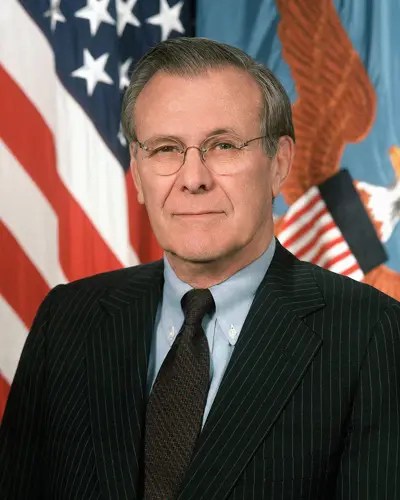
Donald Henry Rumsfeld is a retired American politician. Rumsfeld served as Secretary of Defense from 1975 to 1977 under Gerald Ford, and again from January 2001 to December 2006 under George W. Bush. He is both the youngest and the second-oldest person to have served as Secretary of Defense. Additionally, Rumsfeld was a three-term U.S. Congressman from Illinois (1963–69), director of the Office of Economic Opportunity (1969–70), counsellor to the president (1969–73), the United States Permanent Representative to NATO (1973–74), and White House Chief of Staff (1974–75). Between his terms as Secretary of Defense, he served as the CEO and chairman of several companies.
