Donald Rumsfeld Quotes
The Constitution calls for civilian control of the military and I am a civilian.
Donald Rumsfeld, U. S. Secretary of Defense (Republican), U. S. Congressman (Republican, IL), White House Chief of Staff, Response to a critic who accused him of not deferring enough to the admirals and generals of the Pentagon, Quoted on C-SPAN, Washington Journal, March 5, 2004
Sourced by: Eigen's Political and Historical Quotations


The irony is that it is just for the lack of this fundamental principle that Napoleon eventually became the Government and the Military in France.


There was much argument over the desired relative strength and power of the three branches of government. Wilson suggested equality. We argue about it to this day.


In principle few disagree. However, in practice the norm of American polity is that the civilian leaders must consult the military and or intelligence leaders and take their advice seriously. If they President and his civilian leadership to not take the advice, they pay a heavy political price as there is a sometimes contradictory norm that says that you must allow the military experts to run the battles. In the given case, the Iraq War, the President and Vice President made the decision to invade Iraq. However, if we believe them literally, they were heavily influenced by the intelligence agencies who assured them that Iraq had a nuclear weapon about to be completed. It was a “slam dunk” in the words of the CIA director— {633093}. JFK as a young president did not feel that he could override the CIA and DOD people who had assured him that the Bay of Pigs lading would trigger a massive uprising in Cuba. He was misled but had to take the responsibility for the fiasco where not a single person in Cuba rebelled. The President can and should override the best military advice when it is wrong, but how does he know? If he does, he always pays a short term price—even if he is right, for that is not clear for some time. Politics in a democracy is not easy in a democracy.

Many of the fundamental principles of government that were in the United States Constitution, were already in the Constitutions of different states. Vermont had a substantial number of them. When we speak of the Constitution as a “revolutionary document” it was to the rest of the world but not to many Americans who had these concepts in their state constitutions and had been living with them for some time.

The “departments” refer the 3 branches of government: executive, legislative, and judiciary. The basic principle of the separation of powers (See {607920}) was fundamental to the state representatives at the 1787 Constitutional Convention, even though none of their state constitutions had accepted that principle.

Powell was the Secretary of State and Addington kept advising the administration that as long as the President was acting in defense of the country in his capacity as Commander in Chief, he did not have to obey any existing laws that had been Constitutionally passed which in the opinion of the President restricted or limited the President or the executive branch. Addington was an attorney and Assistant to the Vice President, but he was given much responsibility for administration policy. Powell the Secretary of State of the Administration could not have disagreed more and although most politicians including Republicans disagreed with the Addington thesis, Powell was one of the few Republicans to criticize the Addington position.
Jefferson opposed the formation of a veterans' group after the American Revolution.


This is a classic type of fallacious political logic. The author claims that there are no powers in the constitution to make laws in a number of important areas of our society. What is true, is that there is no explicitly and uniquely specified statements in the Constitution regarding the areas he specified (and some he didn’t like education). However the power to make laws in these areas comes from the “Commerce Clause” where the Federal Government was given the power to regulate Interstate Commerce. And that is what the Federal Government does make laws about. Food that is sold in the state where it is grown is regulated by the states. But interstate agriculture is. Medicines and weapons are also sold and transported in interstate commerce. Even housing is in part covered as financing and mortgages, building materials, working conditions of the building companies are part of Interstate Commerce. A succession of Congresses have recognized this and so has every Supreme Court in our history. McManus however believes that all these legislators and judges have been wrong and worse, part of a conspiracy to subvert the Constitution. See {630683} for his tendency to see conspiracies in politics.


This concept of balance of power and the equal role of the judiciary is actually quite rare. Even in Parliamentary democracies the parliament can override any court interpretation. In England, the upper legislative house, the House of Lords, actually serves as the nation’s highest or supreme court. And these “Law Lords” can override all regular judicial bodies.

Hatch was the chairman of the Senate Judiciary Committee at the time.
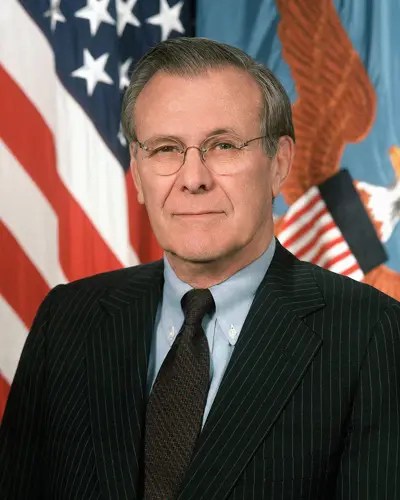
Donald Henry Rumsfeld is a retired American politician. Rumsfeld served as Secretary of Defense from 1975 to 1977 under Gerald Ford, and again from January 2001 to December 2006 under George W. Bush. He is both the youngest and the second-oldest person to have served as Secretary of Defense. Additionally, Rumsfeld was a three-term U.S. Congressman from Illinois (1963–69), director of the Office of Economic Opportunity (1969–70), counsellor to the president (1969–73), the United States Permanent Representative to NATO (1973–74), and White House Chief of Staff (1974–75). Between his terms as Secretary of Defense, he served as the CEO and chairman of several companies.
