William Howard Taft Quotes
We should have an army so organized and so officered as to be capable in time of emergency, in cooperation with the National Militia, and under the provision of a proper national volunteer law, rapidly to expand into a force sufficient to resist all probable invasion from abroad and to furnish a respectable expeditionary force if necessary in the maintenance of our traditional American policy which bears the name of President Monroe.
Taft, William Howard. "Inaugural Address." Washington, D.C., 4 Mar. 1909.

This was an official publication of the U. S. Army. The First World War had very little affect on future military preparedness At that time conservatives in Congress were very isolationist and military preparedness was not a high priority or even a significant political issue. The Democrats then were more supportive of military spending than the Republicans. It took World War II, for which America was very unprepared, to produce a change in public and political opinion regarding military preparedness.


The French and English, with larger numbers and more experienced troops and officers, wanted the American units to come under the command or their officers and be integrated into the allied army. However Wilson established the tradition that American troops fighting abroad most always fight as an American Army under American Command. Although resented then and into the 21st century by America’s allies who are expected to fight under American command, it is a tradition that no American major politician has seriously challenged since then.


The final decision regarding the attack on Pearl Harbor and war with America had to be made. The Emperor Hirohito, Prime Minister Tojo, the full cabinet and leading elder statesmen were invited. Hara attended as one of the latter class. America had instituted an embargo of critical raw material whose end was contingent of Japan withdrawing from the territory that they had invaded and stop their territorial aggression in Asia, an aggression which some Japanese leaders—notably the military—was absolutely necessary to provide for the growing Japanese population and its increasing standard of living. At the time, an embargo was a powerfully effective weapon, which left Japan only two choices: Withdrawal or War. In modern times nations have chosen to endure and evade embargoes rather than be forced into undesirable positions.

This size standing army which alarmed so many at the beginning of the 20th century, looked very small when compared with the standing army of America a century later. For earlier American Politician’s views on a standing army, see {592824}, {631687}, {622888}, and {641008}.

While to Madison the principle that “war is better than tribute” was “settled policy”, there were many who disagreed. See {640867} as an example.

Then Chief of Staff of the Army, he was asking for a large military appropriation.

The French had made a series of major military misjudgments and blunders allowing the German troops to reach the interior of France and threaten to rout the French. General French’s forces were called upon to prevent such a rout and did so costing British casualties and diverting British Armies from their desired offensive operations. Then the British Expeditionary Force was again called upon to come to the aid of the French for the second time. General French pushed back but the British really had no other alternative lest their ally could be enfeebled for the rest of the war. The French military leadership and General Staff was terrible at that point.


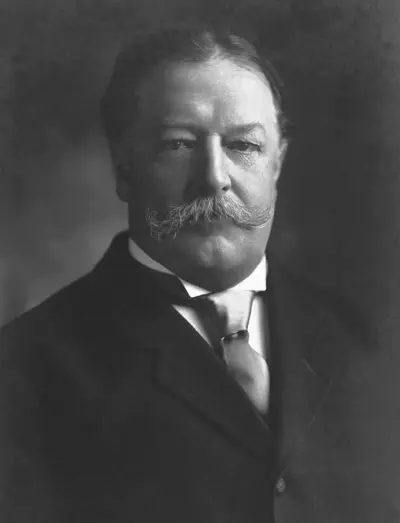
William Howard Taft was the 27th president of the United States (1909–1913) and the tenth Chief Justice of the United States (1921–1930), the only person to have held both offices. Taft was elected president in 1908, the chosen successor of Theodore Roosevelt, but was defeated for reelection by Woodrow Wilson in 1912 after Roosevelt split the Republican vote by running as a third-party candidate. In 1921, President Warren G. Harding appointed Taft to be chief justice, a position he held until a month before his death.
