George C. Marshall Quotes
There is no group today in America who view the possibilities of war with more horror, and consider the large appropriations involved with more reluctance than do the officers of the General Staff. There is no thought in our minds to seize upon the dilemma of this tragic world situation as an opportunity to aggrandize the Army.
Then Chief of Staff of the Army, he was asking for a large military appropriation.
George C. Marshall, 1880-1959, General & U. S. Army Chief of Staff, U. S. Secretary of State, U. S. Secretary of Defense, Congressional Testimony, 1940
Sourced by: Eigen's Political and Historical Quotations

This size standing army which alarmed so many at the beginning of the 20th century, looked very small when compared with the standing army of America a century later. For earlier American Politician’s views on a standing army, see {592824}, {631687}, {622888}, and {641008}.

At that time there were extensive meetings and discussions for the creation of what was to be the United Nations. The negative view of the United Nations or other international security organization is now and always has been held by a vocal minority in the United States.

Greek invaders were marching on Istanbul

This was an official publication of the U. S. Army. The First World War had very little affect on future military preparedness At that time conservatives in Congress were very isolationist and military preparedness was not a high priority or even a significant political issue. The Democrats then were more supportive of military spending than the Republicans. It took World War II, for which America was very unprepared, to produce a change in public and political opinion regarding military preparedness.

America, England, Germany and France Many Japanese leaders predicted war between the Great Powers while America and its European Allies did not see the danger as clearly. Shortly after 1936, Hitler began the Second World War. Japan was indeed prepared. Hiranuma became one of the Japanese extremists and after WWII was convicted of war crimes and given a life sentence.

The final decision regarding the attack on Pearl Harbor and war with America had to be made. The Emperor Hirohito, Prime Minister Tojo, the full cabinet and leading elder statesmen were invited. Hara attended as one of the latter class. America had instituted an embargo of critical raw material whose end was contingent of Japan withdrawing from the territory that they had invaded and stop their territorial aggression in Asia, an aggression which some Japanese leaders—notably the military—was absolutely necessary to provide for the growing Japanese population and its increasing standard of living. At the time, an embargo was a powerfully effective weapon, which left Japan only two choices: Withdrawal or War. In modern times nations have chosen to endure and evade embargoes rather than be forced into undesirable positions.


Since the Partition of India to create the state of Pakistan, Pakistan has wanted to integrate the Muslims—especially near the border. However, many Indian Muslims did not choose to leave India for the new Islamic nation. Pakistan has had designs on some of the Indian areas and has maintained a very large army.


In early America, there was great concern about a standing army—a military force that exists and is organized in peacetime. History showed the founding fathers that tyrants who siezed power almost always did so by getting control of the standing army. The logic was if there is no standing army, no one can control it and therefore no tyrant can control the country by force. At the time, however, with oceans protecting us, there was penty of time to mobilize a defensive army should any foreign power invade. However, with modern military technology, and the importantance of retaliation as a protective3 strategy, it is virtually impossible to not have a standing army and stoll be secure.

Four years later the President embarked on a nation-building effort in Iraq which was beset with many problems.
He was arguing that normal Constitutional limitations should not apply to the President in wartime.


This was written when the United States was not a dominant military power. At the beginning of the 20th century, the U. S. had the same size military as Argentina. It was France, German, Turkey and England who had the military superiority and it was they who tended to find excuses for war. After WWII, the U. S. was dominant and was involved with a number of wars and military incursions, often with nations that had not attacked the U.S. Korns’ principle was most dramatic when the George W. Bush administration invaded Iraq on the excuse that the Iraqis were developing weapons of mass destructions and then might attack the United States. After the successful invasion, the excuse was shown to be hollow as there were no signs of sophisticated weapons development.


Lindbergh, a great aviator, was a Fascist who was a great admirer and supporter of Hitler and Mussolini. By this time, even Lindbergh had seen much of the German aggression, and his opposition to the war was on the pragmatic ground that we could not win. He thought that democracy was too unsuited to a country being a major power.

On military or foreign policy matters his view was that presidents ought not to rule anything in or out so that he/she can keep all the options open and not reduce future flexibility.

At first glance, the reader might think that this quotation in a leading university newspaper was from the Vietnam War era. However, it was argument against U. S. involvement in World War II. There was a very negative reaction to Wilson’s visions and claims for the First World War which never did come to pass that stuck with many.

Congress and most of the Founding Fathers were very distrustful of standing armies. They were aware that standing armies had taken over societies ever since ancient Rome and Julius Caesar.
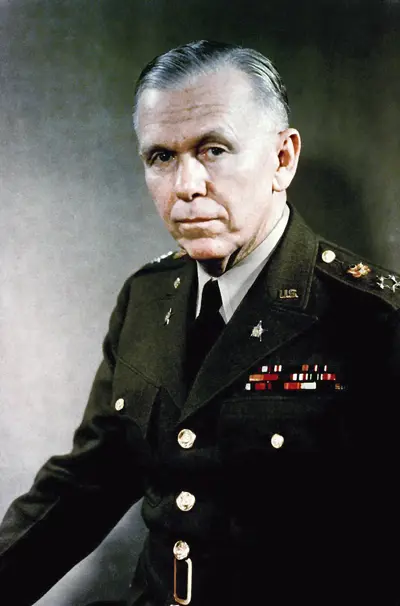
George Catlett Marshall Jr. was an American soldier and statesman. He rose through the United States Army to become Chief of Staff under presidents Franklin D. Roosevelt and Harry S. Truman, then served as Secretary of State and Secretary of Defense under Truman. Winston Churchill lauded Marshall as the "organizer of victory" for his leadership of the Allied victory in World War II. After the war, he spent a frustrating year trying and failing to avoid the impending civil war in China. As Secretary of State, Marshall advocated a U.S. economic and political commitment to post-war European recovery, including the Marshall Plan that bore his name. In recognition of this work, he was awarded the Nobel Peace Prize in 1953.
