Kei Hara Quotes
If we were to give in to the United States, then we would not only give up the fruits of the Sino-Japanese War and the Russo-Japanese War, but also abandon the results of the Manchurian Incident. There is no way we could endure this … the existence of our empire is threatened … there is nothing else we can do.
The final decision regarding the attack on Pearl Harbor and war with America had to be made. The Emperor Hirohito, Prime Minister Tojo, the full cabinet and leading elder statesmen were invited. Hara attended as one of the latter class. America had instituted an embargo of critical raw material whose end was contingent of Japan withdrawing from the territory that they had invaded and stop their territorial aggression in Asia, an aggression which some Japanese leaders—notably the military—was absolutely necessary to provide for the growing Japanese population and its increasing standard of living. At the time, an embargo was a powerfully effective weapon, which left Japan only two choices: Withdrawal or War. In modern times nations have chosen to endure and evade embargoes rather than be forced into undesirable positions.
Kei Hara, 1856-1921, Japanese Prime Minister, Speech at the Super-cabinet Meeting, December 1, 1941
Sourced by: Eigen's Political and Historical Quotations

Every major Western power and Japan were looking to control parts of China for their own mercantile advantage. The Emperor, her adopted son, had stated that under no circumstances would the Chinese fight, but Cixi issued this decree, in effect, overruling the Emperor—a remarkable occurrence.

The United States and England maintained officially that their stance was moral and ethical. And it was for most Americans and Britons. However, there were some, whose motivation was economically self-serving as this quotation suggests. The less control Japan had over China, the more other countries could freely trade with China.


Then Chief of Staff of the Army, he was asking for a large military appropriation.
In 1945 a message was sent to Joseph Stalin from the Japanese purportedly authorized by the Emperor asking the Russians to receive a peace envoy to discuss possible terms for a Japanese surrender. A prince of the imperial household was proposed as the emissary. The allies had already agreed and announced that unconditional surrender was the only alternative, but Stalin and the Russian Foreign Office thought that there might be some advantage gained to have the meeting. However there was one problem that the Japanese had never considered. When Stalin told Truman of the initiative, Truman agreed that no one should meet him.


See {633152} for more of the reasoning for this point. “Neocon” is a shortened form of “neoconservative”. At the time the neoconservatives were advocating use of military intervention in the Middle East. Munich was the German city in which British Prime Minister notoriously tried to appease Hitler and the Nazis. This led to WWII and has become the historical icon for appeasement of a powerful tyrant and the cost of such.

Bland was an expert in Asia and spent most of his time writing about Asian Politics. This quote shows that there was hostility and bad feeling between American and Japan long before WWII. This statement was written in 1921. The reality was that Japan was getting stronger as a militaristic expansionist nation which wanted to subjugate most of Asia. Ironically, they were using England and the European powers as models and sought to take Korea, Manchuria and much of Asia as Colonies, but this clashed with American values and even then there was animosity of the two systems.

Chamberlain’s policy was to appease Hitler and Germany to avoid war. Although he did not see Czechoslavkia as a critical British national interest and claimed he had secured peace {585941} , the reality was that he gave Germany room to start its aggression which would engulf all of Europe and much of the world. The British became the only bulwark against Hitler until the Russians stopped the Germans and America entered the war.


This was very much a minority opinion at the time, and has much historical significance as he was the father of the British Prime Minister, Neville Chamberlain, 1869-1940, whose appeasement of Germany led to Word War II. . See {585941}.

Lindbergh, a great aviator, was a Fascist who was a great admirer and supporter of Hitler and Mussolini. By this time, even Lindbergh had seen much of the German aggression, and his opposition to the war was on the pragmatic ground that we could not win. He thought that democracy was too unsuited to a country being a major power.


This size standing army which alarmed so many at the beginning of the 20th century, looked very small when compared with the standing army of America a century later. For earlier American Politician’s views on a standing army, see {592824}, {631687}, {622888}, and {641008}.


His definition of Russian territory included any area that the Czars claimed which included Poland, the Baltic States, the Ukraine, the Caucuses, but at the time of the speech, Russia was fighting to keep its existing territory.

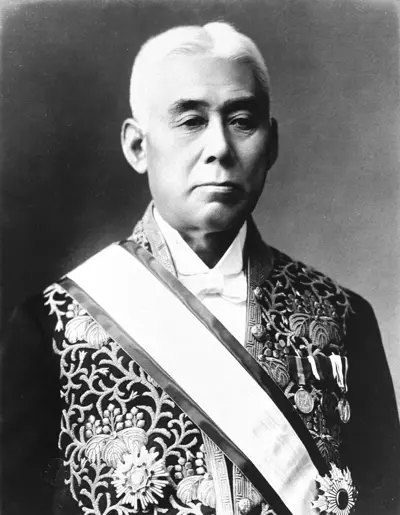
Hara Takashi was a Japanese politician who served as the Prime Minister of Japan from 1918 to 1921.
