Ron Paul Quotes
The war is going to end because we're gonna have such a political and financial havoc here with the devaluation of our dollar, because we just can't keep affording it. This is usually how empires end, by spending too much money maintaining their empire. We're in 130 countries, we have 700 bases around the world, and it's going to come to an end. I want it to come to an end more gracefully and peacefully, follow the constitution, and follow a more sensible foreign policy.
Ronald E. Paul, U.S. Congressman (Republican, TX), Libertarian Nominee for President, CNN, Late Edition with Wolf Blitzer, December 2, 2007
Sourced by: Eigen's Political and Historical Quotations


Chamberlain’s policy was to appease Hitler and Germany to avoid war. Although he did not see Czechoslavkia as a critical British national interest and claimed he had secured peace {585941} , the reality was that he gave Germany room to start its aggression which would engulf all of Europe and much of the world. The British became the only bulwark against Hitler until the Russians stopped the Germans and America entered the war.


Britain was mired in Iraq. They had, as the U. S. would do about 80 years later, gone into Iraq without a viable exist strategy.


Critics of his position observe that the Islamic fundamentalists will never allow girls to go to school even if they were built and they might blow up any school that might be constructed if the allies did not have enough troops in Iraq to protect them and suppress the terrorists. When the Taliban fundamentalists controlled Afghanistan before the coalition drove them out, neither little girls not big girls could acquire education and women were not even allowed to work.


His balanced judgment and concern for American Casualties changed during the Iraq War over a decade later where he insisted on taking steady American casualties even after Saddam had been deposed and American troops were in the middle of a sectarian civil war.
Llewellyn H. Rockwell, Jr.


War has always been a very expensive enterprise. The winner used to require the loser to pay the cost for years afterword, but with the Second World War the U. S. reversed the process. Since then winning a war has been extremely expensive, though not as much as continuing a war without resolution.

Despite the fact that there were no formal political polls at the time, public opinion was very influential in curtailing what might be a tendency to use of the American military. Starting with the Cold War later, Presidents tended to use American military force regardless of public opinion or would exaggerate or lie (Vietnam and Iraq wars for example) to temporally gain some public support.
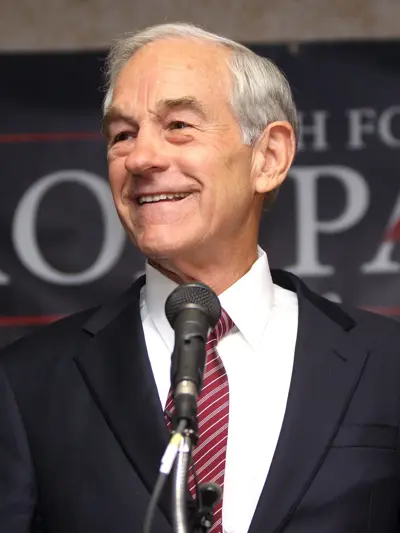
Ronald Ernest Paul is an American author, physician, and retired politician who served as the U.S. Representative for Texas's 22nd congressional district from 1976 to 1977 and again from 1979 to 1985, and for Texas's 14th congressional district from 1997 to 2013. On three occasions, he sought the presidency of the United States: as the Libertarian Party nominee in 1988 and as a candidate for the Republican Party in 2008 and 2012. A self-described constitutionalist, Paul is a critic of the federal government's fiscal policies, especially the existence of the Federal Reserve and the tax policy, as well as the military–industrial complex, the war on drugs, and the war on terror. He has also been a vocal critic of mass surveillance policies such as the USA PATRIOT Act and the NSA surveillance programs. He was the first chairman of the conservative PAC Citizens for a Sound Economy, a free-market group focused on limited government, and has been characterized as the "intellectual godfather" of the Tea Party movement, a fiscally conservative political movement that is largely against most matters of interventionism.
