Mustafa Kemal Ataturk Quotes
The strength of a nation should be expended to defend its own existence. It is totally wrong to forget that and to use one’s forces for the purposes of foreigners. Those who led the war, forgot our own existence and became prisoners of the Germans…
Kemal Ataturk, 1881-1938, 1st President and founder of the Turkish Republic, Criticism of the decision of Turkey to join the Germans in WWI, press conference, 1923, Quoted in Andrew Mango, Ataturk
Sourced by: Eigen's Political and Historical Quotations

Greek invaders were marching on Istanbul


No military alliances has been a tradition in American politics which broke down and changed in our allied effort in WWI. Harding and the Republicans of his day, wanted to reestablish that principle of American Foreign policy. They succeeded, but WWII and its Cold War aftermath made a major change in U. S. policy on this point, and NATO was not only a major permanent military alliance, but lasted well beyond the fall of the Soviet Union. America and our NATO allies were so pleased with the benefits of a permanent military alliance, that they preserved it by looking hard for missions that it could take on rather than dissolve NATO.

He had given a speech and then was accused by several representatives He then returned to the podium with this denial. Throughout history many political leaders have started wars to distract the public from the poor economy of other domestic failures. Many others would never do so. All the former, claim that they are the latter.

There were many who thought that the Russians would view the Mutual Security Act as aggressive and they might respond with some kind of aggressive retaliation and this could lead to war. Others felt that containment would reduce the likelihood of war.


The Turks held and then counterattacked defeating the Greek invaders soundly. The Greeks then retreated and evacuated Anatolia but in vengeance for their defeat, followed a scorched earth policy and committed many atrocities on the Turkish villages they passed through.

This classic, but feeble, claim that Turkey was going to be neutral in WWI. He the ambassador admitted that Turkey had mobilized all its male population, and that a German General on active duty was in command of the Turkish army for “training”, yet they intended to be neutral. Shortly thereafter Turkey and Germany announced an axis alliance which was a great foreign policy blunder for Turkey. Then they (with Germany) lost the war, the Ottoman Empire was broken up in the peace treaty and Turkey went from a huge empire to just a country. Incredibly, later in WWII Turkey made the same blunder and allied and fought with Hitler and Germany again.

Every major Western power and Japan were looking to control parts of China for their own mercantile advantage. The Emperor, her adopted son, had stated that under no circumstances would the Chinese fight, but Cixi issued this decree, in effect, overruling the Emperor—a remarkable occurrence.
China, which had been one of the strongest and most modern nations in the world for 1000 years had lapsed into decay and though a huge nation, rich in resources, with more people than any other had been eclipsed by Japan, America and Europe. Cixi was determined to remedy that, and to a great extent started China on the road to modernization which would take over 100 years more.


The French had made a series of major military misjudgments and blunders allowing the German troops to reach the interior of France and threaten to rout the French. General French’s forces were called upon to prevent such a rout and did so costing British casualties and diverting British Armies from their desired offensive operations. Then the British Expeditionary Force was again called upon to come to the aid of the French for the second time. General French pushed back but the British really had no other alternative lest their ally could be enfeebled for the rest of the war. The French military leadership and General Staff was terrible at that point.

The “proofs” were diplomatic assurances—treaties—that England would guarantee the territorial integrity of Belgium. The British made strong diplomatic efforts to persuade Germany not to occupy Belgium. The German’s none the less send armies in under the excuse that if they did not, the French would occupy the country and have a strategic advantage over them. Diplomacy could do no more good. England had to send troops or renege on its obligations. So England was in WWI.

Ataturk, the great Turkish reformer, was interested in Turkish independence, development, and reform, but was uninterested in the day-to-day administration of government. He knew it had to be done and wanted his friend to be Prime Minister and run the government. Orbay realized that Ataturk would still be the major power in the nation.
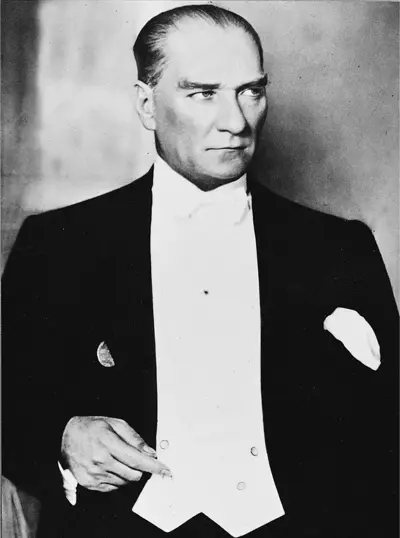
Kemal Atatürk was a Turkish field marshal, revolutionary statesman, author, and the founding father of the Republic of Turkey, serving as its first president from 1923 until his death in 1938. He undertook sweeping progressive reforms, which modernized Turkey into a secular, industrial nation. Ideologically a secularist and nationalist, his policies and theories became known as Kemalism. Due to his military and political accomplishments, Atatürk is regarded as one of the most important political leaders of the 20th century.
