R. Buckminster Fuller Quotes
We must do away with the absolutely specious notion that everybody has to earn a living. It is a fact today that one in ten thousand of us can make a technological breakthrough capable of supporting all the rest. The youth of today are absolutely right in recognizing this nonsense of earning a living. We keep inventing jobs because of this false idea that everybody has to be employed at some kind of drudgery because, according to Malthusian-Darwinian theory, he must justify his right to exist. So we have inspectors of inspectors and people making instruments for inspectors to inspect inspectors. The true business of people should be to go back to school and think about whatever it was they were thinking about before somebody came along and told them they had to earn a living.
R. Buckminster Fuller, 1895–1983, Architect, Philosopher & Inventor, "The New York Magazine Environmental Teach-In" by Elizabeth Barlow in New York Magazine, March 30, 1970
Sourced by: Eigen's Political and Historical Quotations

We never have sat down and thought through the new technologies and worked out any way to ameliorate the ‘creative destruction’ that new technology almost always produces. Mrs. Roosevelt was way ahead of most other politicians for almost a century.


There were by then few jobs left in the American economy that did not require fundamental literacy and most required post secondary education as well.

This is a statement that in the early 21st century would be made only by ultra liberals. But in the in the late 1940’s this was not only standard democratic party thinking, but a large number of Republicans thought of the Government as the employer of last resort including their Presidential standard bearer.


We think of jobs being eliminated when technology is employed as a modern problem. But here, in 1936, automation was eliminating jobs rapidly. One fascinating difference is that Mrs. Roosevelt observes that the laborers jobs are eliminated and the high school and college graduates can run the enterprise. 75 years after this quotation, the jobs of the high school graduates were being eliminated and some higher education was necessary for most jobs. As technology improves, the workers who are necessary require more and more education.

One of the arguments in favor of machinery and automation has always been that new and better jobs are created for the people who run and maintain the machines. However as Marx observed in 1867 that is of no comfort to the person who is replaced by the machine. Also with the computer and modern robots, the control and operation is often done by another computer. Even much of the computer programming is done by computer.

The implication is that we will be able to have cheaper products and cheaper services plus there will be less need for human efforts and few jobs needed and available.


His 50 year prediction was a little too optimistic although a large percentage of the routine, and some non-routine, jobs had become automated especially in the automobile and other manufacturing arenas, and many other fields. But there were still some other jobs that were still being done without machines in 2014. Asimov was essentially right but a little early in his timing.

George was one of the first people to notice that with all the great development and technological breakthroughs, it does not become easier for the lower educated people in society to earn a living. He had not totally focused on education but made the observation for the lower classes where there is a high correlation with education.

Well over a century ago, this prescient economist pointed out that in a very competitive economy, people would have to develop and have multiple skills to remain employable. The competition also produces technological obsolescence.

Bush was the first President to explicitly and publicly explain to Americans the relationship between successful high school and college graduation and unemployment where it did not exist. We were moving ourselves into the information age.


He was pushing the idea of getting the poor and destitute of England to go to the American colonies where a labor force was needed. “Fry” was a term for offspring — children.

One problem critics have with his argument is that while there is always work to be done, there are not always entities willing to pay for the additional work. Gains in productivity will justify investment in more rapid deployment of technology; thus entities in society are will to invest the funds. But if there is no visible economic return from the additional work, corporations and taxpayers may be unwilling to fund it leading to massive unemployment and instability.


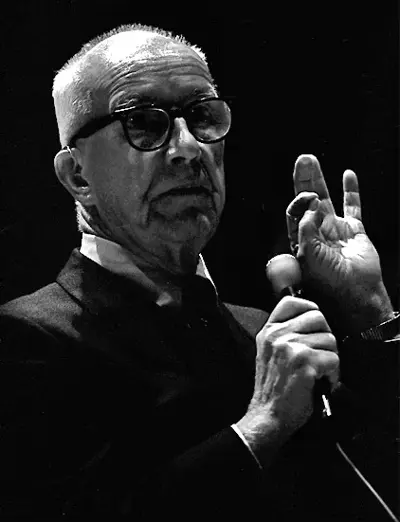
Richard Buckminster Fuller was an American architect, systems theorist, author, designer, inventor, and futurist. He styled his name as R. Buckminster Fuller in his writings, publishing more than 30 books and coining or popularizing such terms as "Spaceship Earth", "Dymaxion" (e.g., Dymaxion house, Dymaxion car, Dymaxion map), "ephemeralization", "synergetics", and "tensegrity".
