Karl Marx Quotes
Capitalist production, therefore, develops technology, and the combining together of various processes into a social whole, only by sapping the original sources of all wealth — the soil and the laborer.
Karl Marx, 1818-1883, German Economist & Socialist, Das Kapital (Book I), 1867
Sourced by: Eigen's Political and Historical Quotations

One of the arguments in favor of machinery and automation has always been that new and better jobs are created for the people who run and maintain the machines. However as Marx observed in 1867 that is of no comfort to the person who is replaced by the machine. Also with the computer and modern robots, the control and operation is often done by another computer. Even much of the computer programming is done by computer.


Technology has always displaced and replaced workers, but most industrial technological breakthroughs, in the long run, have created new jobs and better paid ones. What worried Gompers did not appear to materialize in his lifetime, but actually became and issue on the later years of the 20th century and the early 21st century where the computer the robot, and the sophisticated software began to replace workers at a faster rate than new opportunities were created. Gompers was one of the harbingers of things to come.


Sinclair had written an expose of the meat packing industry – the Jungle – which used as its setting the Armour meat packing factory. It changed the way the public thought about the industry, the role of government and regulation. President Roosevelt took up the reform role, and got Congress to Regulate the quality and cleanliness of the meat packing industry. Sinclair, however not only wanted that reform, but also wanted the labor wages and conditions reformed. He referred to the Armour plant as the fortress.

The first sentence is often quoted by conservatives in defense of the capitalistic system. However most do not realize that Haldane was actually a socialist who was opposed to capitalism. They were unaware of the second sentence which would make them as unhappy as the first made them happy.


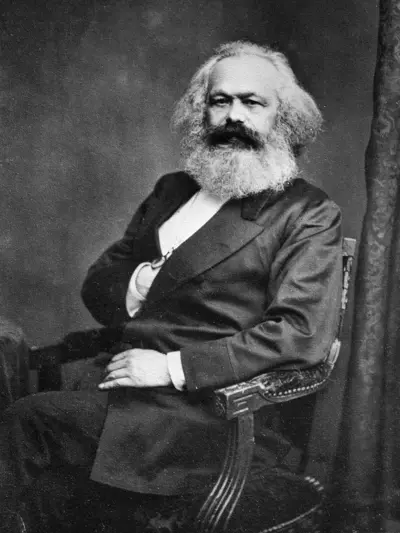
Karl Heinrich Marx was a German philosopher, economist, historian, sociologist, political theorist, journalist and socialist revolutionary. Born in Trier, Germany, Marx studied law and philosophy at university. He married Jenny von Westphalen in 1843. Due to his political publications, Marx became stateless and lived in exile with his wife and children in London for decades, where he continued to develop his thought in collaboration with German thinker Friedrich Engels and publish his writings, researching in the reading room of the British Museum. His best-known titles are the 1848 pamphlet The Communist Manifesto and the three-volume Das Kapital (1867–1883). Marx's political and philosophical thought had enormous influence on subsequent intellectual, economic and political history. His name has been used as an adjective, a noun, and a school of social theory.
