Karl Marx Quotes
Suppose, … that the making of the new machinery affords employment to a greater number of mechanics, can that be called compensation to the carpet makers, thrown on the streets?
One of the arguments in favor of machinery and automation has always been that new and better jobs are created for the people who run and maintain the machines. However as Marx observed in 1867 that is of no comfort to the person who is replaced by the machine. Also with the computer and modern robots, the control and operation is often done by another computer. Even much of the computer programming is done by computer.
Karl Marx, 1818-1883, German Economist & Socialist, Das Kapital (Book I), 1867
Sourced by: Eigen's Political and Historical Quotations

Technology has always displaced and replaced workers, but most industrial technological breakthroughs, in the long run, have created new jobs and better paid ones. What worried Gompers did not appear to materialize in his lifetime, but actually became and issue on the later years of the 20th century and the early 21st century where the computer the robot, and the sophisticated software began to replace workers at a faster rate than new opportunities were created. Gompers was one of the harbingers of things to come.


Computers, robots have replaced many more American workers than those who lost their jobs by having them replaced by foreign labor. Ironically, even in counties like China, South Korea, and a number of others, have "liost" millions of jobs to automation thenselves.


In the Great Recession, the industrial production had improved much by 2012—the 4th year of the Obama administration. However, technology and automation were displacing workers. At the time, the U. S. was producing the same amount as before the Great Recession only it was being done with 5 million fewer workers.
The Grammar Curmudgeon

We never have sat down and thought through the new technologies and worked out any way to ameliorate the ‘creative destruction’ that new technology almost always produces. Mrs. Roosevelt was way ahead of most other politicians for almost a century.
We think of jobs being eliminated when technology is employed as a modern problem. But here, in 1936, automation was eliminating jobs rapidly. One fascinating difference is that Mrs. Roosevelt observes that the laborers jobs are eliminated and the high school and college graduates can run the enterprise. 75 years after this quotation, the jobs of the high school graduates were being eliminated and some higher education was necessary for most jobs. As technology improves, the workers who are necessary require more and more education.


His 50 year prediction was a little too optimistic although a large percentage of the routine, and some non-routine, jobs had become automated especially in the automobile and other manufacturing arenas, and many other fields. But there were still some other jobs that were still being done without machines in 2014. Asimov was essentially right but a little early in his timing.

Although aggregate employment has remained relatively stable as global free trade has become the U. S. policy, there has been major employment disruption with some types of people benefiting and others like blue collar manufacturing workers having their entire careers wiped out. Port cities like Seattle, Baltimore have boomed while Midwestern manufacturing cities have deteriorated greatly.


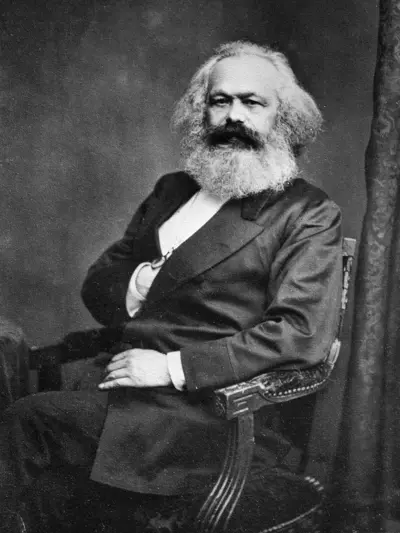
Karl Heinrich Marx was a German philosopher, economist, historian, sociologist, political theorist, journalist and socialist revolutionary. Born in Trier, Germany, Marx studied law and philosophy at university. He married Jenny von Westphalen in 1843. Due to his political publications, Marx became stateless and lived in exile with his wife and children in London for decades, where he continued to develop his thought in collaboration with German thinker Friedrich Engels and publish his writings, researching in the reading room of the British Museum. His best-known titles are the 1848 pamphlet The Communist Manifesto and the three-volume Das Kapital (1867–1883). Marx's political and philosophical thought had enormous influence on subsequent intellectual, economic and political history. His name has been used as an adjective, a noun, and a school of social theory.
