Harry S. Truman Quotes
We are now prepared to obliterate more rapidly and completely every productive enterprise the Japanese have above ground in any city. We shall destroy their docks, their factories, and their communications. Let there be no mistake; we shall completely destroy Japan's power to make war. It was to spare the Japanese people from utter destruction that the ultimatum of July 26 was issued at Potsdam. Their leaders promptly rejected that ultimatum. If they do not now accept our terms they may expect a rain of ruin from the air, the like of which has never been seen on this earth.
At Potsdam the Allies had called for the unconditional surrender of the Japanese and reiterated what had been allied policy that the surrender must be unconditional. Even after the Hiroshima bombing, the Japanese military cabinet voted not to surrender. After the second atomic bomb, the Emperor decided to surrender, but even then there was an attempted military coup to prevent that. Fortunately, the coup failed. We did not have any more atomic bombs immediately ready and it would have taken months to construct more.
Harry S Truman, 1884-1972, 33rd President of the United States (Democrat, MO), Announcing the use of the First Atomic Bomb on Hiroshima, Address Before a Joint Session of the US Congress, April 16, 1945
Sourced by: Eigen's Political and Historical Quotations


Unfortunately, the prime minister turned out to be very accurate in his predictions. The Second World War functioned just as he said.

One of the predictions of the oncoming war with Germany.


There was a significant opposition in England who opposed the war against the rebellious colonies. Fox was one of the most outspoken who thought that England would not win.


This is a significant quotation because the bombing of Hamburg was somewhat controversial. The Germans had bombed Warsaw, London and many other cities contravening the them accepted laws of war. The allies retaliated by bombing German cities where there was extensive war manufacturing; however, there were some allied war planners who saw the bombing of German cities as a way of breaking morale and shortening the war above and beyond the damage to the factories. A new technique had been used in bombing Hamburg—firebombing. Many thousand coordinated incendiary bombs ignited fires throughout the city which combined into a huge firestorm, killing even people with heat that were in air raid shelters. More than 100,000 Germans died—a greater toll than would later take place at Hiroshima and Nagasaki. There was some allied criticism that the firebombing just killed people but made the survivors even more adamant about continuing the fight, This quotation, from a leading German officer, supported the view that there was a strong positive military effect. The technique was repeated in Tokyo to even greater effect before the atomic bombed were ready. (The Japanese had also bombed civilian cities first as well as committed other atrocities.


Bombing had reached the point where conventional bombing raids on industrial cities like Tokyo and Hamburg produced even more civilian casualties than did the atomic bomb at Hiroshima. Tibbets’ view, through the lens of hindsight, was developed by many of the Allied servicemen who had been forced into war by expansionist and militaristic nations like Japan and Germany both of which placed much of their war material manufacturing capability in the midst of their otherwise civilian cities. Both brutally violated the laws of war and committed atrocities many times over before the allies began retaliating. There are still some who believe that it was wrong to drop the atomic bomb on Japan. Some even feel that the mass bombing of Japanese and German cities in retaliation and in furtherance of the war effort was morally wrong. But at the time, the millions of casualties anticipated in the invasion of the Japanese mainland, persuaded virtually every American soldier and civilian that there was nothing wrong with use of the Atomic bomb, and many saw it as an absolute Godsend to prevent all the American and Japanese causalities that would have come otherwise. Many scholars remark on how it was virtually impossible to find any significant number of misgivings before or just after Hiroshima. Tibbet’s view was typical.

The British and American bombing of Germany had become so effective that most of the German industrial system was destroyed. However, early in the War, Germany had violated the Geneva Convention and was indiscriminately bombing London and other part of England. In addition the German Air Force had bombed Warsaw, and many other cities throughout Europe. The German’s had killed over 20 million Europeans. When the Allied bombing produced high collateral damage against civilians, some argued that even though German had deliberately used this tactic, the allies should stop the saturated bombing if there were to be high civilian collateral damage. Others argued that it was unfortunate but a military necessity. There were others like Brenen, who argued that killing German women and children was desirable and just.


In 1930, Japan, Britain, and the United States had signed an agreement that submarines would not sink merchant vessels without having first placed passengers and crew in a place of safety. However, when Japan attacked Pearl Harbor and bombed civilians as well as military and had a pattern of bombing and shelling civilians in China, the U. S. took the position that Japan had abrogated all treaties and therefore abrogated the 1930 treaty. It was more of a symbolic gesture as at the time the American forces were in no shape to attack Japanese merchant shipping though later in the war, it became material. By that time, the Japanese had murdered American prisoners of war on the Bataan Death March and elsewhere and had slaughtered civilians in the Philippines and all the other territories that they invaded. The niceties of the 1930 treaty was one of the first casualties of Japanese aggression.
At Hamburg Harris organized a massive fire bombing of the German industrial city and the fire storm was so great that it sucked the oxygen out from huge sections of the city and thousands of people were roasted alive. Even with 100,000 Germans killed, Harris was convinced that it was a relatively humane way of waging a necessary war when compared to the classic artillery barrage followed by invading soldiers and street to street fighting.


At the time, surprising to most people now, the use of the atomic bomb was not an issue of controversy at all. There were no Congressman who questioned it, no newspapers which editorialized against the use of the bomb. There were not even any other counties which protested its use. The blessing of ending the war, even at the cost of less than 200,000 deaths seemed a clearly desirable tradeoff when compared with the many millions of deaths that would have occurred had the bomb not been used. As an example, the conventional bombing of Tokyo before the nuclear weapons were used killed as many Japanese as either Hiroshima or Nagasaki.


While he thought his own country had been so badly impacted by the war, other nations were in worse shape and suffered more. Russia for example. And of course Germany brought total devastation on itself.

There was much political Japanese opposition to attacking the United States. Most military judgments were that Japan could not win such a war. The militarist hawks in the Japanese leadership argued that while Japan might not be able to defeat the U. S., Japan could not be defeated in the Pacific. And the U. S. would not spend the money to rebuild their navy of the Japanese could destroy most of the capital ships with surprise attack. Therefore starting a war might provide the opportunity to negotiate for more favorable terms and less pressure, boycotting, and castigation of Japan by the United States and they could come out with control of a number of lands of the Pacific. However, the Naval Chief of Staff told the Emperor that war ight be inevitable as America or Great Britain might attack one of the Japanese held territories and force Japan into war. Later, the Japanese conservatives and Militarist hawks, were able to purge opponents of war from the Cabinet, and when they had control of the government, convinced the Emperor to flip flop, and started WWII with the Attack on Pearl Harbor.
At first reading, this is just a common report of a German war correspondent riding along on a bombing mission. However what makes it a very important historical quotation is the description of the fires and the date. In WWII the allies firebombed Hamburg {624722} and Dresden, and were then accused by the Germans—and by some historical revisionists in the 21st century—of bombing civilian cities and using the firbombing technique where one huge conflagrant sucked the air out of the area and roasted even people in bomb shelters. However, it was clear that the Germans had started the bombing of civilian cities, but the firebombing was less clear. This quotation proves that it was the Germans who first broke the rules of war and that made the subsequent Allied use of the technique legal and for most people then moral.


Shortly thereafter the first atomic bomb was dropped on Hiroshima. To this day there is historical debate over whether Japan received enough notice to afford them the opportunity to surrender or whether their cultural imperatives would allow surrender under almost any circumstances. This Japanese rejection of the surrender demand, seems so reckless in retrospect. Even after the second atomic bomb drop, most senior officers of Japan did not want to surrender. Even after the Emperor decided on surrender, there was an unsuccessful coup attempt of officers totally opposed to surrender.
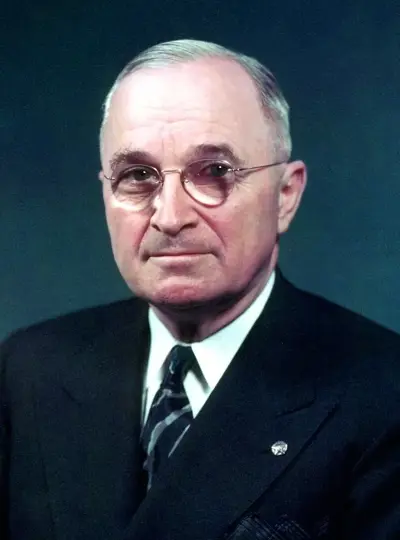
Harry S. Truman was an American politician who served as the 33rd President of the United States (1945–53). He served as a United States Senator from Missouri (1935–45) and briefly as Vice President (1945) before he succeeded to the presidency on April 12, 1945 upon the death of Franklin D. Roosevelt. He was president during the final months of World War II, and approved the plan to drop atomic bombs on Hiroshima and Nagasaki. Truman was elected in his own right in 1948. He presided over an uncertain domestic scene as America sought its path after the war and tensions with the Soviet Union increased, marking the start of the Cold War.
