Winston Churchill Quotes
Air power may either end war or end civilization.
Churchill, Winston. Parliamentary Debates (Hansard), House of Commons, 14 Mar. 1933, vol. 275, col. 1904.


This quotation is very important in helping to understand the 1950s in America with respect to nuclear weapons policy. McCormick was one the better educated, sophisticated, and influential Americans. Yet he appears to be a technological and nuclear ignoramous. Most people had not yet realized that atomic weapons were not just much larger traditional bombs. They could do terrible damage, but it would always be localized they thought. Chicago might be destroyed but the people out of range would be OK. He never got it that a dirty bomb could be dropped on Detroit and depending on which way the wind is blowing could wipe out Chicago and much of the Midwest as well. He knew nothing of the genetic effect the radiation, nor the implications for the environment of maintaining a large nuclear manufacturing industry. He and many like him did not realize that after the first bombs were created, how easy it would be for the Russians and others to also develop a nuclear arsenal. And 50,000 warheads was just a matter of effort. The implications of these things would inhibit our carrying out his and others ideological views of foreign policy. Oppenheimer and most nuclear scientists explained all this, but believing them and acting on those beliefs would have been too much of a change.

At Potsdam the Allies had called for the unconditional surrender of the Japanese and reiterated what had been allied policy that the surrender must be unconditional. Even after the Hiroshima bombing, the Japanese military cabinet voted not to surrender. After the second atomic bomb, the Emperor decided to surrender, but even then there was an attempted military coup to prevent that. Fortunately, the coup failed. We did not have any more atomic bombs immediately ready and it would have taken months to construct more.

Unfortunately, the prime minister turned out to be very accurate in his predictions. The Second World War functioned just as he said.


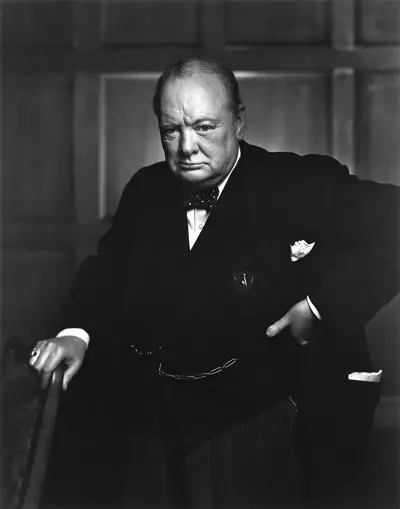
Sir Winston Leonard Spencer Churchill, KG, OM, CH, TD, DL, FRS, RA was the Prime Minister of the United Kingdom from 1940 to 1945, during the Second World War, and again from 1951 to 1955. Apart from two years between 1922 and 1924, Churchill was a Member of Parliament (MP) from 1900 to 1964 and represented a total of five constituencies. Ideologically an economic liberal and imperialist, he was for most of his career a member of the Conservative Party, as leader from 1940 to 1955. He was a member of the Liberal Party from 1904 to 1924. Churchill was also well known for his military career and as a historian, painter and writer, and among his many awards was the Nobel Prize in Literature.
