Hap Arnold Quotes
Now we must smash Japan. We must carry the war to every part of her empire no matter how remote.
Hap Arnold, 1886-1950, Army General in Charge of U. S. Air Forces, Announcement to the air forces after the defeat of Germany in WWII
Sourced by: Eigen's Political and Historical Quotations

Some scholars look back at the allied bombing of German Cities in WWII with criticism that it was morally improper to bomb populated cities, and that the use of the adjective “exterminating” indicated that Churchill was more interested in killing Germans than strategic victory. This revisionist history has two failings. First, the Germans had already bombed Coventry, London and other civilian targets in England as well as cities in Holland, Poland and other countries killing many civilians. As a result, under the rules of war, Germany was no longer entitled to protection for their cities. Further, Hamburg and other targets were manufacturing sites of war material and as such lost the protection anyway. Even Dresden, which had very little war manufacturing was the main location for R&R of German Officers and by their military presence in the city converted it into a legitimate target. FDR agreed with Churchill, that the bombing was a good strategy to cause Hitler to fall as they thought the public would rebel. They were wrong however and his grip on the population through the Gestapo and the military was so strong that, it took a land invasion and occupation to put an end to Hitler. However, the devastating bombing all but crippled the German weapons development and deployment. For example. The Germans had developed the Jet Airplane Engine and actually put a few in the fight at the end if the war. Without the bombing, they would have had many more and countered the allied air supremacy. However, it is also true that Churchill and many Englishmen and some Americans believed that the English were morally entitled to retaliation for the innocent civilians killed with the German bombing of civilian targets.

In 1930, Japan, Britain, and the United States had signed an agreement that submarines would not sink merchant vessels without having first placed passengers and crew in a place of safety. However, when Japan attacked Pearl Harbor and bombed civilians as well as military and had a pattern of bombing and shelling civilians in China, the U. S. took the position that Japan had abrogated all treaties and therefore abrogated the 1930 treaty. It was more of a symbolic gesture as at the time the American forces were in no shape to attack Japanese merchant shipping though later in the war, it became material. By that time, the Japanese had murdered American prisoners of war on the Bataan Death March and elsewhere and had slaughtered civilians in the Philippines and all the other territories that they invaded. The niceties of the 1930 treaty was one of the first casualties of Japanese aggression.


Note that he assumes that not only will there be another World War, but he assumes that we will be on opposite sides.

This quotation is important because the American public and their leaders saw only one course of action—invasion of the Japanese Mainland. The debate was whether to attempt the invasion right away or bomb and blockade Japan into destruction and starvation weakening the population so their resistance would not produce the kind of casualties that we had experienced with the Invasion of Okinawa. The bombing and blockade strategy was selected and 80 percent of Tokyo was obliterated. Yet the Japanese refused to surrender even after all its manufacturing capability was destroyed and the agriculture was beginning to be destroyed. Most Americans did not realize it but the atomic bomb was being made ready for use. After the test bomb in New Mexico, we had enough fissionable material for 2 bombs and it would take several months for each additional bomb. The use of the atomic bomb at the time seemed not much different from the massive bombing that had already taken place. More Japanese were killed in some of these conventional bombings than with the Atomic Bomb. The key believe was that the Japanese would not give up. After the first A bomb, they still would not surrender, and when the Emperor decided on surrender after the 2nd bomb, there was a military insurrection in the palace to stop the Emperor’s surrender message to the people from being broadcast. It was just minutes too late, and the Emperor had to be obeyed. Invasion, with its terrible casualties—many more than the atomic bombs—was unnecessary.


During WWII, Mauldin was at the front lines and in the fox holes with the troops getting ideas for his cartoons most of which were drawn on the battle field;

At Potsdam the Allies had called for the unconditional surrender of the Japanese and reiterated what had been allied policy that the surrender must be unconditional. Even after the Hiroshima bombing, the Japanese military cabinet voted not to surrender. After the second atomic bomb, the Emperor decided to surrender, but even then there was an attempted military coup to prevent that. Fortunately, the coup failed. We did not have any more atomic bombs immediately ready and it would have taken months to construct more.

Umezu was one of several members of the Japanese War Council, that did not want to surrender even after the second atomic bomb destroyed Nagasaki. He and the other hard liners were convinced that the Japanese could inflict such heavy casualties on an invading force of the mainland that the Allies would not insist on unconditional surrender and Japan could negotiate favorable terms. These hard liners had already lived through the firebombing of Tokyo which in casualties was as bad as the atom bomb attacks, and felt that they could maintain a defensive force even if all the major cities of Japan were destroyed. Fortunately for all parties, the Emperor overruled Umezu and the hardliners. Umezu and the other hard liners had personal reasons to want to negotiate terms. They had committed war crimes and did not want to be brought to account. He was tried after the surrender and sentenced to life in prison where he died of cancer after 4 years.

This concept of Total War turns out to be the only way to bring many conflicts to an end. Sherman was hated by generations of Southerners because he appeared to be vengeful to humble the Southern pride and spirit. But actually, Sherman was not personally vengeful at all and respected the South and understood its point of view more than most in the North. However, he was one of the first of the Western World’s military leaders to realize that with modern warfare and the then modern weapons, the only way to win a war was to persuade the enemy to stop fighting and if they refused, as the South kept doing, the only rational and humane course was to end the war as swiftly and totally as possible.

There was much political Japanese opposition to attacking the United States. Most military judgments were that Japan could not win such a war. The militarist hawks in the Japanese leadership argued that while Japan might not be able to defeat the U. S., Japan could not be defeated in the Pacific. And the U. S. would not spend the money to rebuild their navy of the Japanese could destroy most of the capital ships with surprise attack. Therefore starting a war might provide the opportunity to negotiate for more favorable terms and less pressure, boycotting, and castigation of Japan by the United States and they could come out with control of a number of lands of the Pacific. However, the Naval Chief of Staff told the Emperor that war ight be inevitable as America or Great Britain might attack one of the Japanese held territories and force Japan into war. Later, the Japanese conservatives and Militarist hawks, were able to purge opponents of war from the Cabinet, and when they had control of the government, convinced the Emperor to flip flop, and started WWII with the Attack on Pearl Harbor.

He was referring to President Jefferson’s inclination to send the military against the Barbary Pirates. They had an incredible extortion racket going in the Mediterranean. If nations would pay them an annual sum each year, they would not attack and seize merchant ships of that country and sell the ships and goods while holding the sailors for ransom. Note that Congress was not very well respected at that time which Jay and most leaders did not think was a good thing, much like in the 21st century.

The only soldier ever so honored. See {604732} for Japanese attitude toward surrender.

of the German tactics of Blitzkrieg Goering, Hitler and the other leading Nazis were quite open about their military aggression. Terrorism was admittedly used to persuade the next nation Germany would attack to capitulate rapidly.

Hopkins was a social worker with no military of political experience. But the President trusted him implicitly. Most American military officers and Ambassador to England Joseph P. Kennedy, a Nazi sympathizer & father of JFK, believed that England could not stand up to Hitler. Any military aid we gave England would fall into the hands of the Germans. Everyone was shocked when Roosevelt sent Hopkins to England to make a military recommendation. To impress Hopkins with something he thought Hopkins would be interested in, Churchill led a tour of workers cottages built by the government. Hopkins surprised Churchill and his aids who would never forget this statement & then asked to see the military facilities. Hopkins distressed the American military by recommending that Britain could hold out against invasion if they received military aid. Despite the contrary military advice, FDR accepted Hopkins’ recommendations, and the rest is history. He had been right and much of the military wrong.


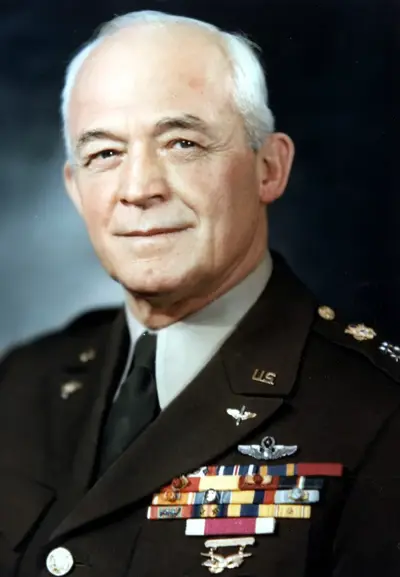
Henry Harley Arnold was an American general officer holding the ranks of General of the Army and General of the Air Force. Arnold was an aviation pioneer, Chief of the Air Corps (1938–1941), Commanding General of the United States Army Air Forces, the only United States Air Force general to hold five-star rank, and the only officer to hold a five-star rank in two different U.S. military services. Arnold was also the founder of Project RAND, which evolved into one of the world's largest non-profit global policy think tanks, the RAND Corporation, and one of the founders of Pan American World Airways.
