Urban II Quotes
We are much rejoiced upon hearing that Your Highness has come to rule Hungary at the order of Almighty God …. You excel in knowledge of church writings, unusual in the secular world and, what is even more fit for a judge’s power, in the knowledge of Holy canons.
Odo of Chatillon-Sur-Marne. Note that the “Divine Right” of monarchy has become a “Devine Command.” Also, that a king was educated (See {591629}) was totally unusual for the times.
Urban II, 1035-1099, Catholic Pope, Letter to Hungarian King Coloman, 1095-1116
Sourced by: Eigen's Political and Historical Quotations


He was stating for France what the English King James I had said a few decades earlier. See {616307}.

Bartolomeo Fiadóni -- Tolomeo da Lucca -- Bartholomew of Lucca
The Emperor had made his brother King of Holland, thinking of it as an unimportant backwater of the French Empire. But Louis took his oath and job very seriously, and although he did not have the great talent of his brother, he made a serious effort to be a good king.


This is one of the passages of the Bible that Christian Kings cited in expecting obedience. Most of the monarchs took this passage to mean that God had selected and appointed them to rule.


This was a fairly radical constraint on what had been a traditional priestly prerogative throughout the ages. However, the penalty for such a sin and infraction was rather modest—a warning for the first offence, followed by reducing the cleric’s income. There were more serious punishments proscribed for repeated offenses, but typical of most reform efforts a newly prohibited activity carries a very light penalty. For example $20 fines for providing alcohol to a minor was the initial penalty in some states. A then current comparison can be made since elsewhere in this council dueling between Christians was also prohibited. But the penalty for even the first offence was excommunication.

This notice of Excommunication was promulgated to the Catholic clergy in Ireland in May of 1538. It required all Roman Catholic leaders to size the property of Protestants or Catholics who sympathized with them. Those who did were then regarded as traitors by the Protestant King. The anti-Protestant feeling culminated with the massacre of about 100 Protestants who were drowned in Bann a few years later.

There was a continuing power struggle between the more powerful kings of Europe and the Roman Catholic Pope. This struggle however was not one of church and state. Neither the kings nor the clergy viewed the two as separate domains. Instead they saw the two in much the same way as the ancient Jews and many contemporary Muslims view relationship—as an inseparable amalgam. However there was much debate over who could best protect and manage the amalgamated entity. In this case Alcuin was arguing that Charlemagne could ensure the well-being of the church better than the Pope. The power struggle went on for centuries between more or less able, powerful, and corrupt kings and popes.

This quotation illustrates the negative attitudes towards democracy that existed with many “leaders” of the time. Stuyvesant was appointed by and reported to the Dutch West India Company—not to the government of Holland. New Amsterdam was a commercial venture just as most of the English American Colonies were. Stuyvesant was not a particularly good governor in terms of both making money for the company or governing the new city.

Joseph ben Matthias. There a different kinds of theocracy, There can be a Pope, a King, or a Supreme Leader who acts as the chief magistrate using a religious tract as the law of the land. The Ancient Jews had a Republican Theocracy were the leaders were chosen by the people but they did not promulgate any laws. The Torah—the first 5 books of the Old Testament—was the law of the land. In comparison. 21st century Iran recognized the Koran as the source of Laws. However, their chief magistrate was a cleric—the supreme leader who is not elected but appointed by a few other clerics. None of the other Iranian leaders are chosen by the people because all candidates must be approved by the Supreme Leader in order to even stand for election. So the ancient Jews had a republican theocracy, while Iran was an autocratic theocracy.

Sometimes referred to as Gaspar de Toledo. This quotation Illustrates one of the ways that Churches maintained power over the secular government even though they were supposedly separate. By maintaining control over the secular leaders consciences and sense of morality, the Church could control the secular government. In this particular historical case, there was not even a supposed separation. The Confessor had an ex officio role in the high council. See {629457}.
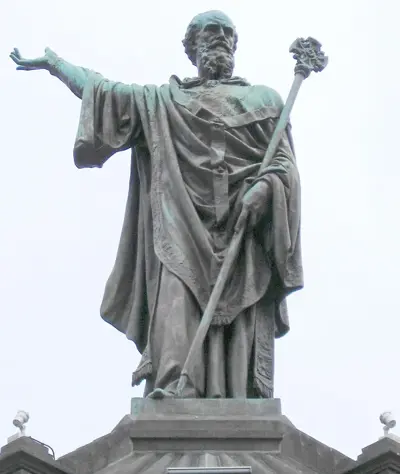
Pope Urban II, otherwise known as Odo of Châtillon or Otho de Lagery, was the head of the Catholic Church and ruler of the Papal States from 12 March 1088 to his death. He is best known for initiating the Crusades.
