John Winthrop Quotes
Judges are Gods upon earth.
John Winthrop, 1588-1649, Puritan Clergyman, Governor, Massachusetts Bay Colony, Arbitrary government described and the Government of the Massachusetts vindicated from that aspersion, 1644
Sourced by: Eigen's Political and Historical Quotations


The government of Pakistan regarded this as seditious. The Government can fire judges at will and the military has the right to convene its own courts and try Pakistani civilians for certain alleged crimes by removing their cases from the civilian courts. Even when a Pakistani judge is not intimidated by the government or the military, the Islamic extremist fanatics often assassinate any public official who any one of thousands of fanatics feels is anti-Islamic.
In most of the world this is an accepted truism. However, where there is judicial independence as in the United States, Israel, Norway, England and other countries, those who appoint judges have little or no control over a judiciary that has lifetime tenure and a tradition of non-interference. The influence is limited to the appointment of a judge with a particular philosophy. However, in some countries, not only do the courts follow the lead of the government but if they do not the judges themselves might be jailed or worse. Borelli’s principle therefore holds there.


White was not confirmed.


Jefferson, like most Presidents and ex-presidents, had his concerns about the judiciary and judicial checks, especially of the Executive Branch.

This shameful quotation was shocking to most readers. It is subject to two interpretations: One that judges who did not rule on Constitutional issues the way conservative extremists wanted would come to physical harm. The other, that conservatives should pressure judges by withholding appropriations for the courts, impeachments and recall elections where they exist, as well as funding potential opponents for those jurisdictions where judges are elected. Both meanings were disgraceful in the view of most Americans. Later, DeLay was convicted and sentenced to jail for money laundering and illegally spending and raising campaign funds. He was also reprimanded by the House Ethics Committee for unethical methods of fund raising for other earlier actions.

Johnson thought that he was 5 votes short to pass the Economic Opportunity Act to launch his War on Poverty. This quotation shows the master of Presidential vote getting in action. Jones came from a very conservative and racist district in Florida. In addition to the general conservative concern about the bill. White Southern racists were still angry about the Civil Rights Act that had just passed and saw the anti-poverty programs as another opportunity for the Federal Government to have racially integrated employment and training programs in the South. If Jones voted for the anti-poverty bill, he might well be defeated in the 1966 election. The President promised to appoint him as a Federal Judge—a lifetime appointment—if he were defeated. A potential problem was that there would not likely be a vacant judgeship open in Alabama. Johnson promised that he would create another judgeship for Jones if necessary—a judgeship that was not really needed. Jones was reelected and President Johnson did not have to create a new judgeship.
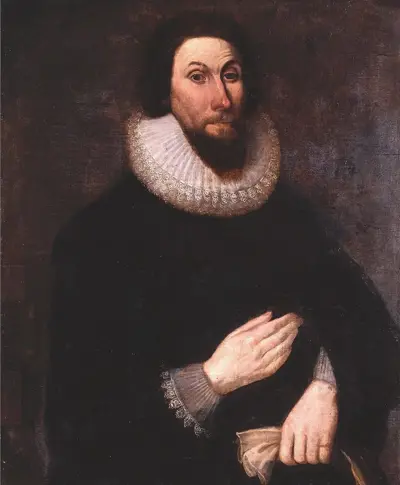
John Winthrop was an English Puritan lawyer and one of the leading figures in founding the Massachusetts Bay Colony, the second major settlement in New England following Plymouth Colony. Winthrop led the first large wave of colonists from England in 1630 and served as governor for 12 of the colony's first 20 years. His writings and vision of the colony as a Puritan "city upon a hill" dominated New England colonial development, influencing the governments and religions of neighboring colonies.
