Byron White Quotes
The purpose of a jury is to guard against the exercise of arbitrary power—to make available the commonsense judgment of the community as a hedge against the over- zealous or mistaken prosecutor and in preference to the professional or perhaps overconditioned or biased response of a judge.
Byron R. White, 1917–2002, U. S. Supreme Court Justice, Taylor v. Louisiana, 1975
Sourced by: Eigen's Political and Historical Quotations


At the time he was not an official of the bar association.

The law was against stealing corn from a farm of field, There was a tradition in Russia that no one should be jailed for corn stealing unless he stole 5 or more ears of corn. However, many people repeatedly helped themselves to 4 ears, and the party wanted it stopped. What is fascinating is that his insistence that the law as promulgated by the Party be enforced literally without regard to issues of higher justice such as starvation and necessity, placed him in the same legal posture as the capitalist countries which also insisted that the laws be enforced and not tempered by higher moral issues of fairness. Whoever has the power to make the laws wants them to be enforced literally. Most others want them tempered by issues of justice, fairness, and necessity.


This was an unusual public chastisement of federal prosecutors by a Senior Federal Judge in a criminal trial. Federal prosecutors meet very high standards to be appointed, but the position of prosecutor has often been a stepping stone to advancement in politics, and sometime the desire to win at almost any cost impinges on the fairness and justice of a case. Of interest in this quote also is the fact that the Judge urged his colleagues to do more publicly to deter these practices.

It is surprising that these ideas would come from one of the most autocratic powerful monarch in the world at the time. However there were many very liberal influences on her from Europe. This set of proposals she even sent to Voltaire to get his feedback and criticism.

Judges were commonly granting injunctions against unions that were boycotting companies, which was then against the law. However, no judge had ever given an injunction against a company to stop them from boycotting individual workers who were known union organizers. Taft, who had a distinguished career as a Judge earlier in his career shocked the business world and delighted organized labor. Considered politically, a Republican running for President publicly advocated a new right and protection for labor organizing, when his party was supposed to protect companies against Labor. Taft however, was not an ideologue, but was a very fair man, and to him this particular issue was simple. Veteran politicians thought that he should have ducked the question, as he would offend much of the Republican base, but he was used to that being the number 2 man in Theodore Roosevelt’s Administration.

Bruce is one of the few American Comedians to so offend the political establishment that he was constantly legally harassed throughout his career. He was actually criminally convicted in New York for obscenity. In 2003 he was posthumously pardoned by the New York Governor, the first posthumous pardon in state history.


Althought most of Seale’s “solutions” were counterproductive and/or ineffectual, and the Black Panthers were regarded as public enemies, Seale was right about some of his complaints including this one. In most of the South the changes forced by the Civil Rights and Voting Rights Acts where just beginning to have significant effect. So there were proportionately very few Blacks on Southern Juries. Even in the North, Blacks did not register to vote in proportion to their numbers so since jury pools were then usually drawn from voter registration lists, Blacks were statistically underrepresented. When a few Blacks were put on a jury panel, the prosecutor had the right of preemptory challenge as did the defense. But there were enough challenges so that the prosecutor could disqualify all the African Americans on the Jury. Even today, this is legal in many jurisdictions and although better than in 1970, then a Black defendant would rarely have African Americans on the jury of “his peers.”


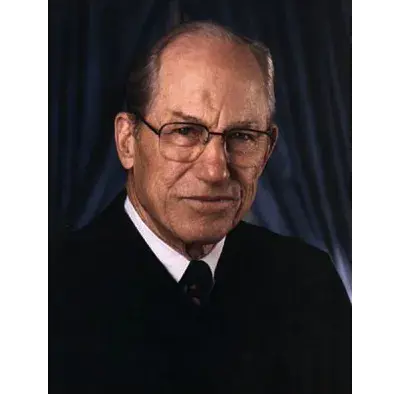
Byron Raymond "Whizzer" White was an American lawyer and professional football player who served as an Associate Justice of the Supreme Court of the United States from 1962 to 1993. Born and raised in Colorado, he played college football, basketball, and baseball for the University of Colorado, finishing as the runner up for the Heisman Trophy in 1937. He was selected in the first round of the 1938 NFL Draft by the Pittsburgh Pirates and led the National Football League in rushing yards in his rookie season. White was admitted to Yale Law School in 1939 and played for the Detroit Lions in the 1940 and 1941 seasons while still attending law school. During World War II, he served as an intelligence officer with the United States Navy in the Pacific Theatre. After the war, he graduated from Yale and clerked for Chief Justice Fred M. Vinson.
