Peter Stuyvesant Quotes
We derive our authority from God and the West India Company, not from the pleasure of a few ignorant subjects.
This quotation illustrates the negative attitudes towards democracy that existed with many “leaders” of the time. Stuyvesant was appointed by and reported to the Dutch West India Company—not to the government of Holland. New Amsterdam was a commercial venture just as most of the English American Colonies were. Stuyvesant was not a particularly good governor in terms of both making money for the company or governing the new city.
Peter Stuyvesant, 1592-1672, Dutch Governor of New York, View of the basis of his authority, Quoted in Liberty Magazine
Sourced by: Eigen's Political and Historical Quotations


This is one of the passages of the Bible that Christian Kings cited in expecting obedience. Most of the monarchs took this passage to mean that God had selected and appointed them to rule.

This and many other statements have been used to refute the allegation made by some that the Japanese Emperor and Commander in Chief had no influence and control over the military and thus was not responsible for any war crimes.

He was stating for France what the English King James I had said a few decades earlier. See {616307}.

It is you who have called us unto this office; but being thus called we have our authority from God;
Then the Deputy Governor, Winthrop had been attacked as being too authoritarian. The conceptual struggle with democracy, divine right, and religion had begun in America long before the American Revolution. There is an interesting parallel with the current debate over Islamic attacks on democracy by an Islamic party being elected, but then responsible to God and not only the people who elected them.


She was running for the United States Senate. God must have chosen her opponent as she lost.
This Biblical quotation has been used for more than a thousand years by Christian authorities, civil and religious, to induce obedience to the existing authority and suppress revolution.


This sura is seen as a limit on power of a ruler.

Odo of Chatillon-Sur-Marne. Note that the “Divine Right” of monarchy has become a “Devine Command.” Also, that a king was educated (See {591629}) was totally unusual for the times.
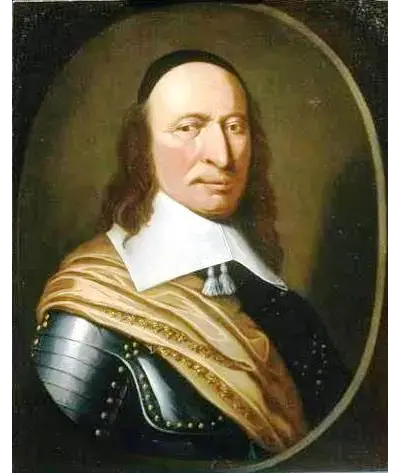
Peter Stuyvesant served as the last Dutch director-general of the colony of New Netherland from 1647 until it was ceded provisionally to the English in 1664, after which it was split into New York and New Jersey with lesser territory becoming parts of other states. He was a major figure in the early history of New York City and his name has been given to various landmarks and points of interest throughout the city (e.g. Stuyvesant High School, Stuyvesant Town, Bedford–Stuyvesant neighborhood, etc.).
