Thomas Hobbes Quotes
Unnecessary laws are not good laws, but traps for money.
Thomas Hobbes, 1588-1679, English Political Philosopher, Leviathan, 1651
Sourced by: Eigen's Political and Historical Quotations

This is a very important historical and political quotation. The first clause shows us that earmarks and private bills for the benefit of individuals and their commercial enterprises are not a new form of corruption; they have existed ever since there have been legislatures.
The most important aspect of this quotation is the SECOND clause. Very frequently, this is quoted alone without the context of the first clause. Taken alone, the meaning seems to be that the more corrupt governments pass the most laws, and there is an implication that fewer laws mean less corruption. This interpretation fits perfectly with the conservative ideology of the late 20th and early 21st centuries that believed that the smaller the government, the better; the fewer the laws passed, the better. However with the context of the first clause, we see that what Tacitus was criticizing the legislature that passed many earmarks and bills benefitting special interests. The more of these that were passed, the more corruption he argued. So he did not object to laws per se. He was not opining on the relationship between the number of laws and a corrupt government if the laws are for general benefit and not for special interests. Out of context, it might appear that Tacitus was supporting the small government, conservative philosophy. In context, he is arguing against earmarks and special interest legislation and supports what we call “good government” which has been bipartisan in America with parts of each party agreeing with Tacitus and other parts of each party trying to pass earmarks and special interest legislation.


1st Baron Verulam


He was discussing “Stand Your Ground Laws” which were enacted to solve one problem, but then effected many other things negatively. The law, once passed, is the law regardless of whether it has adverse consequences that the legislators never anticipated. This is one of the reasons that drafting legislation is such a difficult skill.


Johnson had proposed an extremely strong civil rights bill. Most Washington insiders assumed that he would gain favor amongst fair minded whites and Blacks for making the attempt, but then he would compromise with the Southerners, and water down the bill to something that had little or no teeth. His staff were trying to learn from Johnson, which aspects of the bill he was willing to compromise on assuming that the President could never get Congress to pass the bill in its original form. They were really surprised at the President’s answer and assumed that he could not do it. They were more surprised when he did drive the bill through Congress without any substantive compromises. It was the most powerful and effective Civil Rights legislation passed since Reconstruction a century earlier.
Johnson was an incompetent scientist who had developed a method for “squaring a circle” which was in reality totally invalid. It involved the mathematical number Pi which is an infinite decimal but Johnson wanted it to be a fixed number. He persuaded members of the legislature that things would be better in the state if the value of Pi would be fixed by law. So a bill was introduced to make Pi equal to 3.2. Professor C. A. Waldo was horrified that the state would even attempt to legislate what is a mathematical phenomenon. However, Pi was long known to be an infinite decimal with no finite fixed number that can ever be accurate. There were religious and other legislative objections to the notion of an infinite number and one that was not defined as the common man could use it. Hence the proposed legislation. Even if there were a fixed decimal legislated for Pi, 3.2 was definitely in error. For hundreds of years mathematicians the world over had calculated PI to a number of decimal places and the 3.{596032} (commonly in use) was much closer. Professor Waldo persuaded the legislature to abandon their attempt to legislate science and mathematics, and this advice was generally heeded in the United States until some of the states with few scientists and few highly educated citizens began to ban the teaching of evolution. Science and mathematics do not lend themselves to politics and legislation, and still governments often try to legislate science and technology but rarely do it well and without error. The one exception is the setting of standards for units of weights and measurement where consensus is what is important and there is no scientifically right solution. For example, the standard length of a yard can be set at any distance as long as all agree to use that distance. Here government helps a great deal to forge and document the standard.


America’s first political economist


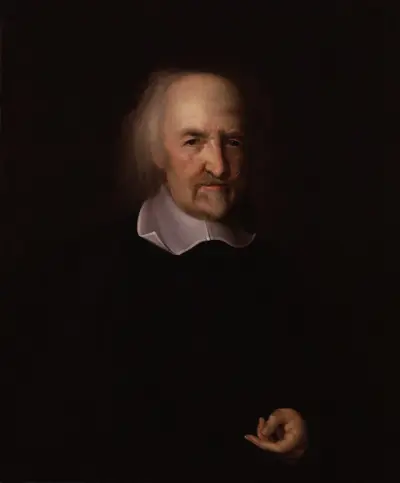
Thomas Hobbes was an English philosopher, considered to be one of the founders of modern political philosophy. Hobbes is best known for his 1651 book Leviathan, in which he expounds an influential formulation of social contract theory. In addition to political philosophy, Hobbes contributed to a diverse array of other fields, including history, jurisprudence, geometry, the physics of gases, theology, and ethics, as well as philosophy in general.
