Lyndon B. Johnson Quotes
I’m going to passing the Civil Rights Bill and not change one word of it. I’m not going to cavil, and I’m not going to compromise.
Johnson had proposed an extremely strong civil rights bill. Most Washington insiders assumed that he would gain favor amongst fair minded whites and Blacks for making the attempt, but then he would compromise with the Southerners, and water down the bill to something that had little or no teeth. His staff were trying to learn from Johnson, which aspects of the bill he was willing to compromise on assuming that the President could never get Congress to pass the bill in its original form. They were really surprised at the President’s answer and assumed that he could not do it. They were more surprised when he did drive the bill through Congress without any substantive compromises. It was the most powerful and effective Civil Rights legislation passed since Reconstruction a century earlier.
Lyndon Baines Johnson, 1908-1973, 36th President of the United States (Democrat, TX), Statement to Jack Valenti, 1921-2007 and other aides, 1964
Sourced by: Eigen's Political and Historical Quotations


The President wanted Anderson to relay his message to other Republicans which he did. At that time the Southern racists were almost all members of the Southern bloc of the Democratic Party. Most Republicans were then advocates of non discrimination. By 2010 virtually all the racists, nativists, neo Nazis, anti Catholics, and anti Semites had gravitated to the Republican party if they were still active in politics. Reasonable Republicans were embarrassed as reasonable Democrats had been before the shift which resulted from passing the Civil Rights Act of 1964.


Humphrey was the Mayor of Minneapolis then.
He was right. Even the vaunted Southern Filibuster was broken by the strategy and tactics Johnson and Senator Humbert Humphry, the Floor Leader for the 1964 Civil Rights Bill.


Arkansas Governor Faubus ordered the national guard to prevent Black students from integrating Central High School in Little Rock. President Eisenhower was a man of action and not rhetoric and his lack of firm public statements overlooked an opportunity to use the Presidential “bully pulpit” and exercise his moral leadership and authority. Armstrong was irate at Eisenhower for appearing to do nothing and say nothing. See {615852}. When Eisenhower did enforce the court order and used Federal troops, Armstrong sent him this congratulatory telegram. His reference to walking into the schools was in support of many who suggested that the best thing the President could have done was to personally take one of the Black students by the hand and walk into the school with him or her. With the mood of the Southern racists, such an act was potentially very risky for the President and it is not known whether of not the President and his staff ever considered such an act.

This statement in the President’s Second Inaugural. Infuriated the politicians of the Southern States. Remember, at the time there was brutal discrimination throughout most of the South, and more important to the South than the fact if the discrimination was their perverse view that this was a right, proper and necessary state of affairs for the welfare of the people and was required by Christianity’s mandates as they read the Scripture. For the President to state so publicly that discrimination was contrary to the law, justice, good faith, citizenship and fairness was a major shock. Since the early days of reconstruction after the Civil war in the Grant Administration, no president had spoken so publicly and openly against the Southern status quo.


The following year most of the Southern Democrats joined the Republican Party in Protest over the Civil Rights Act. Reagan began to have national political ambitions and therefore flip flopped and stated that he would never have voted for the Civil Rights Act. This made him acceptable later as a conservative.

At the time, the Southern segregationists were all Democrats and they blocked any Democratic attempt to pass any Civil Rights legislation. When he could not get a Civil Rights commitment from his own party, Powell turned to the Republicans and the President wrote this letter. In return, in November, Powell endorsed and supported Eisenhower instead of Stevenson, his own party’s nominee. Eisenhower could not get any legislation on Civil Rights as the Southern Democrats would always block it. When President Lyndon Johnson finally forced the 1963 Civil Rights Act through the Congress, the racist Southern Democrats cut a deal with Goldwater and the conservative Republicans, and switched parties. Since then the Civil Rights stance of the two parties reversed. The Democrats were thereafter pro Civil Rights and the Republicans, the party of Lincoln and Reconstruction, thereafter reversed their Civil Rights position and opposed progress in this area.

What made this quotation very dramatic was that the state of Virginia, under the previous administration dominated by religious fundamentalists had passed a law banning same sex marriage. Several private Virginia citizens had sued the State in Federal Court, asserting that their Constitutional rights were violated by the ban. The Attorney general normally defends the state in any court proceeding. However, Herring agreed with the plaintiffs on the case, that the Virginia law was unconstitutional, so he and the State entered the case on the side of the plaintiffs and against the state law. His reference to the right side of history was related to the fact that as late as 1964 Virginia had a law prohibiting interracial marriage which they enforced and the Supreme Court invalidated. Thus, on marriage, Virginia had a track record of being on the wrong side of history and the law.


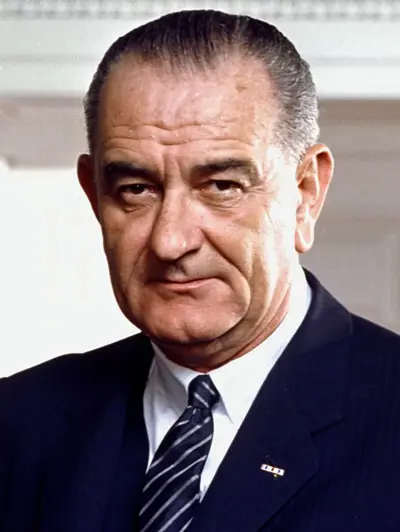
Lyndon Baines Johnson, often referred to by his initials LBJ, was the 36th president of the United States, in office from 1963 to 1969. He served as the 37th vice president from 1961 to 1963 and assumed the presidency following the assassination of President John F. Kennedy. A Democrat from Texas, Johnson was also a United States representative and later majority leader in the United States Senate. Johnson is one of only four people to have served, at various times, in all four federal elected positions.
