William Rawle Quotes
To call an individual from private life in order that he may preside over the interests of millions; to invest him with the various dignified functions, and the extensive patronage which appertain to a station so exalted; to secure as completely as possible, the free exercise of the people's rights; to discourage and prevent the artifices of party, and of individual ambition; and to accomplish all this by means of a fixed and practicable system which should neither be misunderstood, perverted nor resisted, was a task of no small difficulty.
Note that early constitutional experts assumed that one of the President’s roles was to be non partisan and control partisanship. Note the phrase ‘prevent the artifices of party’. The early founders were very wary of political parties of ‘factions’ as Madison called them. However, most were extremely partisan although in the Presidency partisanship was toned down by George Washington but after him, partisan ship became the norm.
William Rawle, 1759–1836, Attorney & Constitutional Scholar, A View of the Constitution of the United States, 1825
Sourced by: Eigen's Political and Historical Quotations


He was a Republican who served a Democratic President to the distress of some of the extreme right wingers of the Republican Party.

She was one of the very few remaining bi Partisan Republicans. There had been a de facto purge of liberal Republicans from the party.


Many people have erroneously credited the water’s edge analogy to senator Arthur Vandenberg who made the same point very effectively in 1950. See {36673}.

For Turgot, see below
In the 1952 steel seizure case the justice department took the position that the President's actions were not reviewable by the courts. The judge ruled against Baldridge and the government.


This is but another example of term limits in early America.


Alberto Gonzalez, White House Counsel and later Attorney General who was forced to resign and David S. Addington, Counsel to the Vice President, had come up with a novel view of the powers of the presidency. They argued that since the President is the Commander in Chief, in a war situation or intelligence gathering thereto, has the Constitutional responsibility for that function, he need not obey any laws of Congress as in the conduct of the war Congress would be impinging on the Constitutional separation of powers which itself was prohibited by the Constitution. The argument did not find any significant legal support but for a while the George W. Bush White House behaved as if this were the law, despite the fact that even in the American Revolution and the War of 1812 Congress passed laws regulating the conduct of the armed forces as is provided for in other parts of the Constitution. Yet even Goldsmith would allow the President some powers that many think are unconstitutional and/or belong to Congress. See {32436}.


His role was the equivalent of the Mayor of Washington DC. Even though the Congress had generally been the most powerful branch of the government, public opinion on this was beginning to shift at the turn of the 20th century.


1st Earl of Beaconsfield
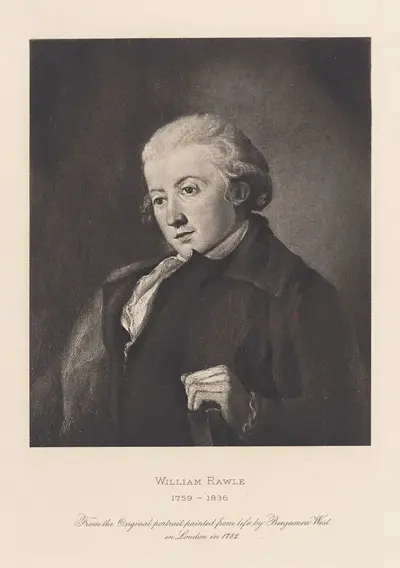
William Rawle was an American lawyer in Philadelphia, who in 1791 was appointed as United States district attorney in Pennsylvania. He was a founder and first president of the Historical Society of Pennsylvania, president of the Pennsylvania Abolition Society, and for 40 years a trustee of the University of Pennsylvania.
