John Marshall Quotes
Throughout this vast republic from the St. Croix to the Gulf of Mexico, from the Atlantic to the Pacific, revenue is to be collected and expended; armies are to be marched and supported. The exigencies of the nation may require that the treasure raised in the north should be transported to the South.
Prior to this important case, many politicians were of the opinion that the Constitution prohibited taking tax money from one state and spending it in another. There was almost an assumption that States will raise the taxes and expend the funds that are necessary of the society.
John Marshall, 1755-1835, Chief Justice of the U. S. Supreme Court, U. S. Congressman (Federalist, VA), U. S. Secretary of War, U. S. Secretary of State, McCulloch v. Maryland, 1819
Sourced by: Eigen's Political and Historical Quotations

Although the Professor was often right about this technique, at the time he made this statement, the Clinton administration was actually cutting spending and using much of the revenue to pay for the deficit—just the opposite of what the Professor was worried about. It was successful and the deficit was eliminated and surpluses were projected. However the succeeding administration more closely followed the professor’s pattern and increased spending enormously for serious needs, but also cut taxes, so that we went during the Bush administration from the largest projected surplus in American history to the greatest deficit in American history.

Opposing the ratification of the United States Constitution: Left before it ended.


This has long been a principle of most politicians responsible for taxation and national budgets. A forced loan, was a practice where instead of taxing and industry like banks, the government requires that the loan the government a certain amount which the government pays back with interest. For the banker, this is preferable to a bank tax which he will never get back,, but then the interest has to be paid by everyone. If the benefit or its potential is to accrue to all citizens, then all the citizens should share in the burden—hence general taxes. See {639883} for a similar contemporary view.


Kennedy, with great Republican support proposed a reduction of the top income tax rate from 91% to 65%, reduction of the bottom rate from 20% to 14%, and a reduction in the corporate tax rate from 52% to 47%. That put the tax rates at the appropriate level. Economic growth was reasonable until President Reagan’s military spending cold war strategy produced huge deficits, Clinton raised the tax rates slightly and had the best economic growth ever, and had a balanced budget. George W. Bush lowered taxes had much slower growth and even larger deficits. However, by 2013 all hints of bipartisanship were gone. The Republicans claimed that the then tax rates were much too high—the highest income tax was half the rate that most agreed in 1962 was the right rate. And the corporate tax was 35 %, far lower than the Kennedy rate of 47% and incredibly lower when we consider that with deductions that were then in force the average corporate tax was only 12% the lowest since the Great Depression. Meanwhile the 2008 Bush Economic Meltdown and the Great Recession it produced the highest deficits in history with the lowest taxes in modern times and much of the polarized population demanding further tax cuts and an equal number demanding increased tax revenue.


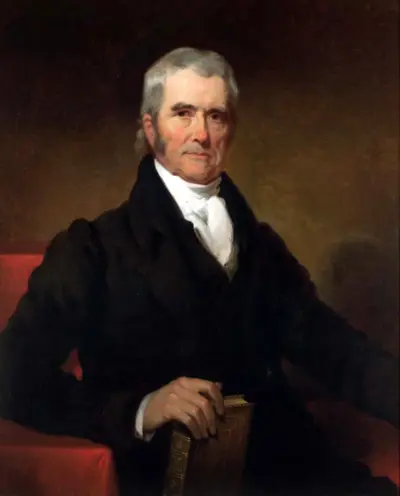
John Marshall was an American politician and lawyer who served as the fourth Chief Justice of the United States from 1801 to 1835. Marshall remains the longest-serving chief justice and fourth-longest serving justice in Supreme Court history, and he is widely regarded as one of the most influential justices to ever sit on the Supreme Court. Prior to joining the Supreme Court (and for one month simultaneous to his tenure as Chief Justice), Marshall served as the United States Secretary of State under President John Adams.
