Peter Beinart Quotes
Foreign policy debates are frequently segregated from domestic policy ones, so commentators who propose increasing the defense budget or sending more foreign aid are seldom asked to explain which domestic programs they’d cut or which taxes they’d raise, in order to find the money.
Peter Beinart, Editor, New Republic, “Putting Ukraine in its Place”, The Atlantic, June 2014
Sourced by: Eigen's Political and Historical Quotations


Most Republicans at the time would argue for government spending reductions except for defense spending for which they wanted an increase in most cases despite huge waste and abuse in the Department of Defense. (See {615006} for just one example). Mulvaney, a new congressman with Tea Party backing, pointed out the hypocrisy of the this Republican position over the last decades, but this had been a central part of the Ronald Reagan platform.

In the non-defense side of the budget a very large proportion of the budget is for entitlements like Social Security and Mediacre which are obligations that must be paid. The remainder, the smaller part is everything else--funding the cabinet departments, all the medical and sdcientific research, all the federal aid to public dchools and police departments, all the welfare, foodstamp and other programs for the poor, the costs of the Federal COurt System, the White House, the Congress, the State Department, foreign aid, Homeland security, weatehr forcasting, all the agricultural programs, and viirtually everything the governmetn does. In 2017 President Donals Trump submitted a budget to COngress that increased defense spending by a fulll 10 percent, and gave a hugh tax cut for the wealthy and the corporations. To balance the budget, he propsoed eliminateing man of the existing progrms like "Meals on Wheels" which brings at least 1 hot meal a day to homebound poor eldertly people, and a host of other critical programs. He had no previous experience with a government budget which was thoudands of times larger and more complex than any budget he had ever seen. So many in Congress, in both partiesd, were very critical of the budget and Congress then started to create its own buget. This quote expressed the heart of the problem.


Attacking opponent Ronald Reagan's campaign promises:. Anderson lost the election. Reagan made good on the last two of the three promises, but ran up the largest deficits in American history.


During the Iraq War, President George W. Bush, cut taxes several times as part of his economic philosophy. The result he claimed kept the economy sound. It also plunged the nation into the highest national deficit in U. S. History.


Jefferson was opposed to a standing army or a buildup of revenue even in case of war. He thought that a national surplus might tempt an administration to engage in war. This was one of the biggest differences between the Jeffersonians or Republican Democrats as they called themselves and the Federalists led by George Washington and John Adams. Washington was a strong advocate of military preparedness, while Jefferson believed that a nation which had a strong army and war chest would be too easily tempted to use it. That debate has raged in America since. However, at the beginning of the second world war, the then conservative party, the Republicans, had adopted the Jeffersonian view and it was FDR and the Democrats arguing for armament and preparedness. The United States was terribly unprepared for war, but mobilized rapidly and won the day. Since then both parties have supported military preparedness and the political argument has been over the degree, but there are few Jeffersonians left when it comes to military preparedness.

Although the Professor was often right about this technique, at the time he made this statement, the Clinton administration was actually cutting spending and using much of the revenue to pay for the deficit—just the opposite of what the Professor was worried about. It was successful and the deficit was eliminated and surpluses were projected. However the succeeding administration more closely followed the professor’s pattern and increased spending enormously for serious needs, but also cut taxes, so that we went during the Bush administration from the largest projected surplus in American history to the greatest deficit in American history.


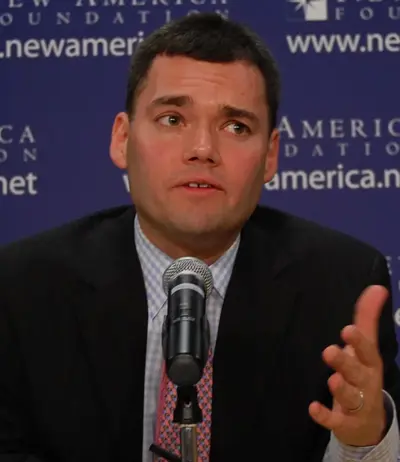
Peter Alexander Beinart (/ˈbaɪnərt/; born 1971) is an American columnist, journalist, and political commentator. A former editor of The New Republic, he has written for Time, The New York Times, and The New York Review of Books among other periodicals. He is also the author of three books. He is a professor of journalism and political science at the Craig Newmark Graduate School of Journalism at the City University of New York. He is an editor-at-large at Jewish Currents, a contributor to The Atlantic, a political commentator for CNN, and a fellow at the Foundation for Middle East Peace.
