Ben Bernanke Quotes
To avoid large and unsustainable budget deficits, the nation will ultimately have to choose among higher taxes, modifications to entitlement programs such as Social Security and Medicare, less spending on everything else from education to defense, or some combination of the above.
Ben Bernanke, Chairman, Federal Reserve Bank, Speech given to the Dallas Regional Chamber of Commerce, April 7, 2010
Sourced by: Eigen's Political and Historical Quotations


In the non-defense side of the budget a very large proportion of the budget is for entitlements like Social Security and Mediacre which are obligations that must be paid. The remainder, the smaller part is everything else--funding the cabinet departments, all the medical and sdcientific research, all the federal aid to public dchools and police departments, all the welfare, foodstamp and other programs for the poor, the costs of the Federal COurt System, the White House, the Congress, the State Department, foreign aid, Homeland security, weatehr forcasting, all the agricultural programs, and viirtually everything the governmetn does. In 2017 President Donals Trump submitted a budget to COngress that increased defense spending by a fulll 10 percent, and gave a hugh tax cut for the wealthy and the corporations. To balance the budget, he propsoed eliminateing man of the existing progrms like "Meals on Wheels" which brings at least 1 hot meal a day to homebound poor eldertly people, and a host of other critical programs. He had no previous experience with a government budget which was thoudands of times larger and more complex than any budget he had ever seen. So many in Congress, in both partiesd, were very critical of the budget and Congress then started to create its own buget. This quote expressed the heart of the problem.


Although the Professor was often right about this technique, at the time he made this statement, the Clinton administration was actually cutting spending and using much of the revenue to pay for the deficit—just the opposite of what the Professor was worried about. It was successful and the deficit was eliminated and surpluses were projected. However the succeeding administration more closely followed the professor’s pattern and increased spending enormously for serious needs, but also cut taxes, so that we went during the Bush administration from the largest projected surplus in American history to the greatest deficit in American history.


Kennedy, with great Republican support proposed a reduction of the top income tax rate from 91% to 65%, reduction of the bottom rate from 20% to 14%, and a reduction in the corporate tax rate from 52% to 47%. That put the tax rates at the appropriate level. Economic growth was reasonable until President Reagan’s military spending cold war strategy produced huge deficits, Clinton raised the tax rates slightly and had the best economic growth ever, and had a balanced budget. George W. Bush lowered taxes had much slower growth and even larger deficits. However, by 2013 all hints of bipartisanship were gone. The Republicans claimed that the then tax rates were much too high—the highest income tax was half the rate that most agreed in 1962 was the right rate. And the corporate tax was 35 %, far lower than the Kennedy rate of 47% and incredibly lower when we consider that with deductions that were then in force the average corporate tax was only 12% the lowest since the Great Depression. Meanwhile the 2008 Bush Economic Meltdown and the Great Recession it produced the highest deficits in history with the lowest taxes in modern times and much of the polarized population demanding further tax cuts and an equal number demanding increased tax revenue.


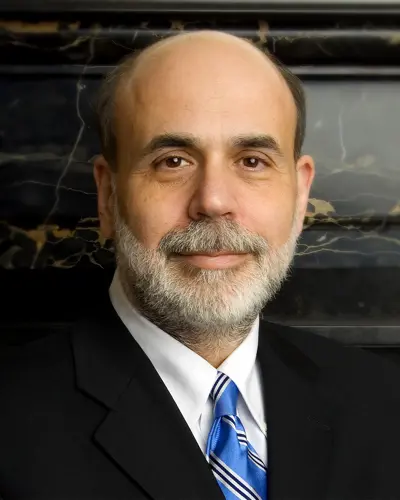
Ben Shalom Bernanke is an American economist at the Brookings Institution who served two terms as the 14th Chair of the Federal Reserve, from 2006 to 2014. During his tenure as chair, Bernanke oversaw the Federal Reserve's response to the late-2000s financial crisis, for which he was named the 2009 Time Person of the Year. Before becoming Federal Reserve chair, Bernanke was a tenured professor at Princeton University and chaired the department of economics there from 1996 to September 2002, when he went on public service leave.
