Milton Friedman Quotes
A long term tax cut is not a tax cut at all unless it is accompanied by a spending cut.
Milton Friedman, 1912-2006, Nobel Laureate in Economics, Quoted by Peter Peterson, Speech, Institute for International Economics, August 9, 2004
Sourced by: Eigen's Political and Historical Quotations


In 1964 the treasury secretary asked the president how to sell the proposed budget to Congress:

After many years of deficit financing, Clinton finally produced a balanced budget and together with his Secretary, of the Treasury, Robert Rubin, actually developed an economy which was producing a huge annual surplus that would soon eliminate the national debt. However, when George W. Bush replaced Clinton after two terms, Bush was unable to manage the budget any better than the other aspects of the Presidency. He cut taxes dramatically and even after it was clear that the Clinton surplus was squandered, he continued tax reductions and even increased them while increasing government spending creating the biggest government in history and went from our largest surplus to our largest deficit in his 8 years.


Goldwater was the first Republican Presidential Candidate since the end of WWII who had campaigned for smaller government and reduced government spending. He actually started the modern Republican trend toward campaigning on this theme. Ronald Reagan did a much better job of campaigning on this theme, and all Republican Candidates since have campaigned on these two themes. It is not clear whether the Republicans were actually serious about this or just ran on the themes to please the political wing that Goldwater had started or meant it but were not good enough at running the government to fulfill this promise. Every Republican President from Reagan through George W. Bush increased the government spending and increased the number of government employees—more so than most Democrats ironically. Democratic President Bill Clinton was the only post WWII president to cut spending, produce a surplus and diminish the size of the government bureaucracy. Goldwater was so intellectually honest that had he won, he probably would have done everything he could to implement the policy of smaller government and less spending.


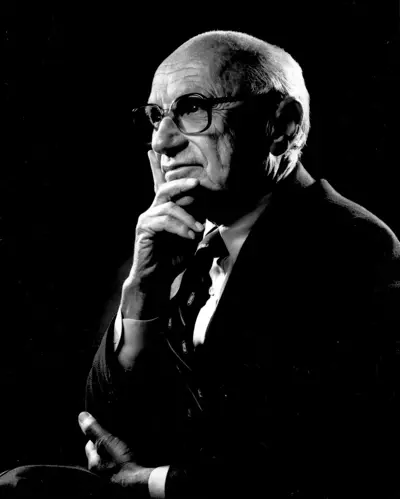
Milton Friedman was an American economist and statistician who received the 1976 Nobel Memorial Prize in Economic Sciences for his research on consumption analysis, monetary history and theory and the complexity of stabilization policy. With George Stigler and others, Friedman was among the intellectual leaders of the Chicago school of economics, a neoclassical school of economic thought associated with the work of the faculty at the University of Chicago that rejected Keynesianism in favor of monetarism until the mid-1970s, when it turned to new classical macroeconomics heavily based on the concept of rational expectations. Several students and young professors who were recruited or mentored by Friedman at Chicago went on to become leading economists, including Gary Becker, Robert Fogel, Thomas Sowell and Robert Lucas Jr.
