Lyndon B. Johnson Quotes
Like Ike [President Eisenhower] did. Talk economy and then spend away.
In 1964 the treasury secretary asked the president how to sell the proposed budget to Congress:
Lyndon Baines Johnson, 1908-1973, 36th President of the United States (Democrat, TX), Instructions to Douglas Dillon, 1964, Quoted in M. Miller, Lyndon B.: An Oral Biography, Putnam, 1980
Sourced by: Eigen's Political and Historical Quotations


Perry was one of a number of politicians who became opposed to deficit spending, and claimed that the public was not interested in the various projects. However, whenever any of these politicians proposed projects or programs to cut, there would be many citizens who would object vehemently. It was precicely because there was a constituency supporting all the government programs that politicians found it so hard to keep spending under control. Indeed, when others suggested terminating spending on programs and projects Perry liked, he objected as strenuously as most others.


This is a particularly interesting historical quotation. It shows that when FDR was first elected, he had a classic view of deficit spending. However, above all, Roosevelt was a pragmatist and not an ideologue. Faced with the Great Depression that was not getting much better, Roosevelt turned around, changed his mind and policy about deficits and embarked on the “pump priming” approach of injecting substantial Federal spending into the economy and accepting the deficits in order to improve the situation which had been stagnant. FDR’s new policy staved off total disaster, but few remember that his great success was a total reversal of his earlier views.


An unusual feature of the American governmental budgeting process is that Congress has passed a law limiting the amount of debt that the United States can maintain. When there is deficit financing, the law limiting the debt has to be changed periodically as the nation approaches the debt limit. Partisan politicians often take advantage of the fact that the debt limit must be passed and hold the passage hostage to obtaining something they want. The reality is that when Congress passed the previous budgets, they determined what the debt would have to be later. So they have already voted to exceed the budget ceiling. But the requirement of doing it in a second forum allows more pressure to be placed on the administration and the other party’s Congress members. While this process is ongoing, many people in the world are worried and often terrorized by the prospect of the debt ceiling not being passed, in which case the United States would have to default on its obligations—not pay interest, contractors, retirements, salaries, etc. Hence the admonition that the debt ceiling should never be a part of the budget negotiating process by most responsible statesmen and women. But the mist partisan of the politicians want to play politics with the debt ceiling precisely because the stakes are so high and they can get both headlines and leverage.


After the Stock Market crash of 1929, Republican politicians promised "recovery is right around the corner." But La Guardia disagreed:
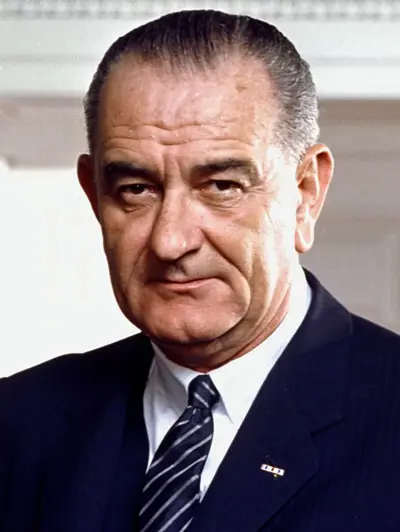
Lyndon Baines Johnson, often referred to by his initials LBJ, was the 36th president of the United States, in office from 1963 to 1969. He served as the 37th vice president from 1961 to 1963 and assumed the presidency following the assassination of President John F. Kennedy. A Democrat from Texas, Johnson was also a United States representative and later majority leader in the United States Senate. Johnson is one of only four people to have served, at various times, in all four federal elected positions.
