Scott McClellan Quotes
The White House Iraq Group–WHIG–was set up ... to coordinate the marketing of the [Iraq] war ...
For some people it was shocking that an administration would establish a high level White House group to "market" a war. See {583420} for one of the ways WHIG functioned.
Scott McClellan, White House Press Secretary (Republican), August 2002
Sourced by: Eigen's Political and Historical Quotations

See {583419} for more on this technique.


Sinclair was a writer who had written about some of the worst scandals in American politics, leaned toward socialized democracy, and decided to run as a reform candidate in California where he lived. He won the Democratic primary easily even though he had no money, political experience, or backing. He terrified the Republicans who ran one of the dirtiest campaigns in American History to defeat him spending more money than in any election up to then including the Presidential elections. (for more details see {619613}) Sinclair lost, but it was close.


This was his most famous speech.

Ailes was the inventor of the "Video News Release", a deceptive practice which was so successful that politicians of all political stripes started using it. Then government agencies started promoting their programs using it. But soon private corporations adopted Ailes technique and made the Video News Release a mainstream advertising and public relations technique and by 1990, it had lost all ethical taints and was used throughout the world with very little of the old moral and ethical compunctions or stigma.


This quotation is of critical importance as it shows that the Germans were actually planning the First World War. See {642092} for another quotation on the subject.

Prior to this question, Thomas had not been called on at a White House press conference for 3 years. After it, she was again avoided.


President George W. Bush, to justify the invasion of Iraq had told the public that the Iraqi regime was developing nuclear weapons and other weapons of mass destruction, and had participated in the September 11 attack on the United States by assisting Al Qaeda. It turned out that these statements were false. The administration claimed that their error was well intentioned and the result of faulty intelligence. Opponents claimed that the administration officials knew that they were exaggerating and had pressured the intelligence agencies to create intelligence conclusions that supported their story.

After the invasion, much of the intelligence upon which America relied on Invading Iraq turned out to be completely wrong. It turned out that the Vice President at least, a major supporter of the invasion, had a role in “shaping” the intelligence and analysis to achieve a policy objective.
This has been true in just about every conflict. In WWII however, there were a highly disproportionate ration of atrocities with those of the axis forces dwarfing those of the U. S. and its allies. Further, after the war, those allied atrocities that did take place were published. In addition, one basic difference is in the policies of the fighting forces and their governments as opposed to individual actions by soldiers. In WWII, the allied atrocities were of the latter type, but the axis atrocities involved both.


In December of 1940 President Roosevelt delivered a Fireside Chat calling for full aid to Britain. The senator described it as:

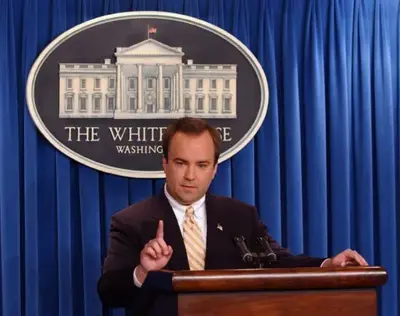
- Born: February 14, 1968
- Nationality: American
- Profession: Politician
Scott McClellan was the 22nd White House Press Secretary (2003–06) for President George W. Bush, and author of a controversial No. 1 New York Times bestseller about the Bush Administration titled What Happened. He replaced Ari Fleischer as press secretary in July 2003 and served until May 10, 2006. McClellan was the longest serving press secretary under George W. Bush.
