Mustafa Kemal Ataturk Quotes
The Turks were a great nation even before they adopted the Muslim religion…The religion founded by Muhammad was based on a policy of setting Arab nationalism above all other nationalisms.
Ataturk wrote this manual personally. Religious Turks took violent offense to Ataturk’s proclamation that Turks were great without Islam.
Kemal Ataturk, 1881-1938, 1st President and founder of the Turkish Republic, A Manual On Turkey For Western Scholars, 1929
Sourced by: Eigen's Political and Historical Quotations

Few non-Arab Muslims would publicly admit this historical truth, and at the time this view was shocking to the most religious men in Turkey. However it resonated with many of the average citizens. The entire Arab world had been subject to and controlled by Turkey, and amongst the Turks, the backward Arabs, were not very popular and were historically seen as underdeveloped colonial subjects.

This quotation illustrated the extreme polarization between the current fundamentalist Muslims, and the Muslim modernists and the West. Kamal Ataturk, the great leader and stateman who is the father of modern Turkey, is castigated by the author for leading the new Turkish parliament to depose the Caliph – the civil and religious autocrat, one of whom reigned from after the death of Muhammad till his abolishment in 1924. Most of the rest of the world credits Ataturk with being one of the great leaders of all time—one who led a democratic revolution which transformed Turkey into the only Muslim secular democracy, requiring pubic secular European type education for all children, giving women the right to vote (before the U. S. even), adopting a European alphabet and dress, and outlook on life—creating most remarkably a total cultural revolution with virtually no loss of life. No revolutionary leader, before or since has led so extensive a political and cultural revolution, and it was a bloodless revolution. Turkey, into the 21st century, was by far the most powerful, industrialized, scientific and modern nation of Muslims in the world and others were far behind. Yet many Islamic theologian still castigate Atatork for his great achievements as being against the will of God.

This notion of the country of the Turks encompassed half of Europe and all of the Mideast
The palace, which had belonged to the Ottoman Caliphs, who were called “Shadows of Allah on Earth”.
Islam prohibits drinking alcohol. Ataturk was the first Muslim politician not only to drink alcohol, but to do so publicly and make a public toast. Unfortunately he became addicted and died early as a result of his alcoholism. Ironically, to this day, he is used by Turks and other Muslims both as an example of the right to drink alcohol and also by those who appreciate the wisdom of Muhammad in banning alcohol.
Ataturk wrote this manual personally as he not only wanted to Westernize Turkey but also generate a climate for acceptance of his vision for a reformed Turkey amongst the Western nations.

The Germans allied themselves with the Islamic insurgency of the day as a strategic maneuver. The Grand Mufti of Jerusalem broadcast propaganda from Nazi radio in Berlin and was dispatched to organize Muslim fighters in Iraq. Fascism was introduced into the Middle East and the Arabs and Persians saw it as a natural extension of their authoritarian and highly prescriptive forms of religious and civil government. 60 years later, there would be Islamic Fascists throughout the Middle East in control or vying for control of many of the countries.

In September of 2005 a Danish Newspaper published some political cartoons showing the hypocrisy of some Muslims who use Islam to justify murder of innocents and terrorism. Months later, in January of 2006 many in the Middle East protested vehemently and Muslim riots broke out because the Prophet Muhammad's visage was depicted against Islamic tradition. Many Muslim nations started a boycott against Denmark. Many Muslim leaders claimed that insulting religion was an “abuse” of freedom of speech including those from nations which regularly publish material that is virulent against Christians and Jews. The Sheikh along with many other Muslims called for the death penalty for the cartoonist who was exercising his Danish right of freedom of expression.

This is another of De Tocqueville’s prescient statements that in retrospect seem so amazing given the time. This quotation could serve as an op ed in a newspaper of any of the industrial democracies of the early 21st century. However, he did not have the information of the details we have today that showed Islam as the pinnacle of scientific, philosophical, literary and medical achievement at the beginning of the second millennium, while the Christian nations of Europe were mired in the Dark Ages. It was the same Koran but a very different interpretation and framework that led to the decadence while it was the Protestant Reformation that triggered a Christianity that was hospitable to modernity and enlightenment.

The Ottoman Turks had just conquered the city of Constantinople including the Eastern Roman Empire in their domain. They would be the dominant power in the area until the First World War when they made the mistake of siding with the Germans and the Ottoman Empire was broken up in the Treaty of Versailles.
“Musselman” was then a term for Muslims used by Europeans. The Arabs then, as many terrorists still do, commonly captured American and European ships enslaving the crews and passengers or holding them for ransom. Jefferson and Adams explained that if this could not be stopped and resolved it might mean war. The Americans could not understand why they were attacked when American had done nothing to offend the Arab Counties. The Arab envoy explained their “duty” and “right” to attack Americans and why war was not a serious deterrent to Islamic nations. Ironically, the same explanations were given by Arab leaders in the early 21st century to illustrate why the Arab countries could not be intimidated.
Turks and Arabs tend to blame each other for the stagnation of Islam.


This is an example of the politicization of history. Late in the first millinium Islamic warriors invaded and conquered much of Hindu India. The Muguls controlled much of India for hundreds of years. When the English conquered India, the Muslims rejected Western education and legal systems while the Hindus did not. After several generations the Hindus, better educated, and more sophisticated in Western ways took advantage of the numerical majority and regained control under the British. With Independence, Islamic nationalists insisted upon partition of the country creating a Muslim country, Pakistan. Millions of Indians were murdered in internecine attacks during the partition. Subsequently, Muslim historians have written one version of the history of India, while Hindu historians have written another. They appear to come from different planets or parallel universes. British historians have a third universe.


This quotation illustrates that the Muslim conquest and attempt to destroy and desecrate the symbols of other religions was not limited to Christianity—it was ALL other religions. In that sense, Christianity and Islam of the period were very similar at the time—intolerance to the point of murder and destruction of any “heathen” religion.

Aeneas Sylvius Piccolomini. 6 years earlier, the Ottoman Turks, had captured Byzantium (Constantinople, later Istanbul), the capital of the Eastern Roman Empire. One o the reasons the city fell was the squabbling of the different Christian national armies about support for the city and the internal bickering of those armies and navies that were there. The Emperor, Constantine XI, the successor to Constantine the Great—the roman Emperor who Christianized the Empire, was killed. Emperor Justinian had built the Hagia Sophia—the largest church at the time and for 1000 years thereafter under a single dome, and this great house of Christianity was turned into a Mosque by the Islamic conquerors.

This was another historical reality that shocked traditionalists. There was nothing in the Koran or Islamic scripture requiring women to wear veils and burkas. Many Muslims and non-Muslims, to this day, do not realize that.

This statement is so absurd, that one marvels that an agency of the United States Government could publish such a statement. It was all the more embarrassing in that the FBI had as one of its objectives developing relationships with Muslim communities across the country. The FBI did withdraw the publication, but there were dozens of FBI officials who read this and approved its publication. They were either themselves Islamaphobic and/or extremely ignorant. One of the worst things about such a statement, is that it does not warn about one real problem that some extremist Muslims want modern Islamic states to adopt a literal view of the Koran which reflects 7th century values, knowledge, and culture. Those fundamentalists have kept modernism from changing and developing several Islamic countries. Most Muslims nations have very little that resembles 7th century Arabia and a nation like Turkey is more modern than many of the nations of Europe.

The reason he claimed that Governor Taseer was a blasphemer was that the governor opposed death penalty for saying or writing anything that was heresy or blasphemy as interpreted be fundamentalist Muslims. The Governor knew he was taking a risk. See {620970} .
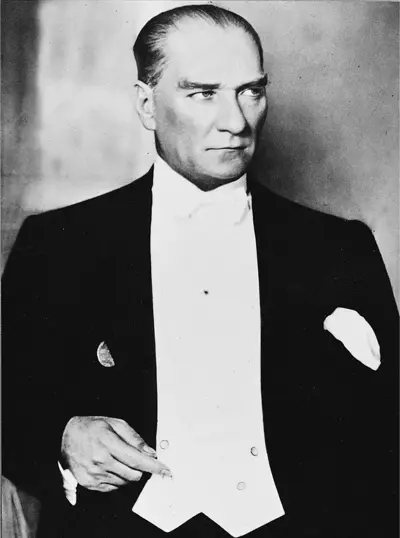
Kemal Atatürk was a Turkish field marshal, revolutionary statesman, author, and the founding father of the Republic of Turkey, serving as its first president from 1923 until his death in 1938. He undertook sweeping progressive reforms, which modernized Turkey into a secular, industrial nation. Ideologically a secularist and nationalist, his policies and theories became known as Kemalism. Due to his military and political accomplishments, Atatürk is regarded as one of the most important political leaders of the 20th century.
