Mustafa Kemal Ataturk Quotes
Poverty, and material and moral misery, are everywhere. There is little to cheer us. Unfortunately, this is the true state of the country. It’s not our fault: unthinking rulers, ignorant of the way of the world, have run this country for years, not to say centuries, and reduced a paradise to this sorry state. Most of our officials are inexperienced and at a loss. Our poor people have ability, but they have fallen under the influence of superstitions which have been presented as sacred dogma.
Kemal Ataturk, 1881-1938, 1st President and founder of the Turkish Republic, A statement to his secretary, March 1930, Quoted in Andrew Mango, Ataturk
Sourced by: Eigen's Political and Historical Quotations

At the time, Muslim clerics had a great deal of influence and in many cases legal control over all facets of Turkish society much as exists in other Islamic societies today. They even controlled what was taught in the schools. Remarkably, without bloodshed, Ataturk broke both the power and the influence of the clerics on all official and public activities. Many Turkish Muslims even developed a type of reformed Islam with the relationship between the individual and the clerics one of parity much like Protestant churches in the West. At the same time there was a more orthodox part of the population and while they sent their children to religious schools, they also attended public schools so even the orthodox Muslims in Turkey learned science and modern subjects which are still not taught in most Islamic schools and madrassas.
This is a very Jeffersonian type statement.
Ataturk wrote this manual personally. Religious Turks took violent offense to Ataturk’s proclamation that Turks were great without Islam.

He insisted that Turks wear hats rather than the class-specific traditional headwear. Some Turks preferred the word “modernized” to “civilized.”
Public money had traditionally been spent to support shrines of Muslim saints. Ataturk ended such subsidies.
The palace, which had belonged to the Ottoman Caliphs, who were called “Shadows of Allah on Earth”.


While critics of Islam cite this sura to show how absurd the Koran can be and contradicts what is known about the Earth’s orbit, few sophisticated, moderate Muslims believe this. However, even in the United States there are many Christians and Orthodox Jews who not only deny Evolution but also believe the Earth is 6000 years old. The basic difference is that in Islamic countries publicly critiquing such anti-scientific theological statements is rare and an individual who publicly argues against the Koran taken literally is often in danger from state or private retribution. In the West the conflict between the Bible and known science is not only publicly commented upon but in a somewhat derisive way. However, consider this: Islam is about 1500 years old. When Christianity was the same age, Galileo was tried and convicted by the Catholic Church for denying this very statement. Perhaps in another 700 years Muslims will look back with embarrassment on this as most of Christianity does.
This sura is used by fundamentalist Islamic regimes to justify religious persecution and prohibit any public worship other than Islam. Jews and Christians went through this stage and there are still a few fundamentalist extremists who would deny freedom of religion if they could. While the percentage is small, those in Islamic nations are a much larger proportion of the whole.

Ingersoll was considered to be the greatest orator and political thinker of his day, but his overt atheistic views curtailed his elected political career.

At the time Islam was quite conflicted about the role of innovation, science and reform. Innovators were to many theologians as dangerous to society as heretics and had to be refuted. Al-Ashari’s school of thought has prevailed in much of the Muslim world to this day.
In 1925 his administration had passed a law banning the wearing of the traditional Muslim hat.
When the Turks defeated the Christians, the only explanation many Christians could conceive of was that God was on the side of the Turks.
In 1856 Turkey and its Ottoman Empire was struggling with new ideas and attempts to reform before they were hopelessly engulfed by modernism. A set of reform laws were passed in February of 1856 which horrified the conservatives and traditionalists. But interestingly the orthodoxy of the Greek minority were unhappy with their legal elevation if it meant that all would be equal. The Minister’s description of opposition to the reforms was somewhat self-serving in that he opposed most of the reforms and wanted to maintain the traditional Islamic state.


This article was originally directed against non-Muslim religions who actively sought to convert Muslims. However, Islamic organizations, have also historically made their greatest inroads with the poor and ignorant members of a society. The madrassas of Pakistan, the activities of Hezbollah, in Lebanon, and Hamas in Gaza all have common characteristics with the Salvation Army where services are provided for the poor and often uneducated with the required participation in religious services, education and/or prayer. There are many Christian, Muslim, and other religious leaders who do not approve of such attempts at conversion, but there are forces within these same religions who not only take advantage of poverty and ignorance to convert but are almost exclusively devoted to that tactic. The Russian Orthodox Church had the same protest against Protestant sects targeting the poor after the fall of the Soviet Union. In general, most religions see nothing wrong with converting people in times of crisis, so long as they are doing the converting. But if another religion is converting their adherents, then it is a violation of human rights.

Voltaire had little respect for any organized religion, but found Islam particularly barbaric and absurd. However he was also very negative about Christianity. See {621191} . The Ottoman Empire, centered in Turkey, then controlled all the Islamic countries of the Middle East. Europeans then often referred to all Muslims as “Turks.”
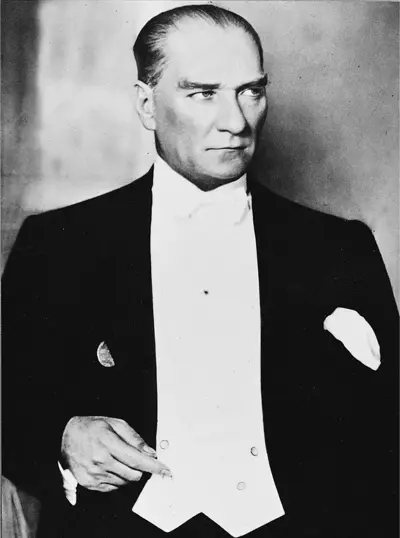
Kemal Atatürk was a Turkish field marshal, revolutionary statesman, author, and the founding father of the Republic of Turkey, serving as its first president from 1923 until his death in 1938. He undertook sweeping progressive reforms, which modernized Turkey into a secular, industrial nation. Ideologically a secularist and nationalist, his policies and theories became known as Kemalism. Due to his military and political accomplishments, Atatürk is regarded as one of the most important political leaders of the 20th century.
