Mustafa Kemal Ataturk Quotes
Skullcaps, fezes, turbans – it all costs money which goes to foreigners. We will become civilized…We will march forward…Civilization is a fearful fire which consumes those who ignore it.
He insisted that Turks wear hats rather than the class-specific traditional headwear. Some Turks preferred the word “modernized” to “civilized.”
Kemal Ataturk, 1881-1938, 1st President and founder of the Turkish Republic, Speech at Kastamonu, August 24, 1925
Sourced by: Eigen's Political and Historical Quotations

At the time, headwear identified the wearer’s caste and class. Fezes, Turbans, etc. were eliminated in favor of hats. This was Ataurk’s solution to two problems: He wanted to have Turkey modernize and develop along the lines of Western democracy and the traditional Islamic headgear being replaced by Western hats were daily symbols of the national modernization. The second advantage was that Turks could no longer identify caste and class by the traditional headgear and the society became much more egalitarian which it has been ever since.

In 1925 his administration had passed a law banning the wearing of the traditional Muslim hat.
In 1925 his administration had passed a law banning the wearing of the traditional Muslim hat. See {593676} for his reasoning.
At the time, Muslim clerics had a great deal of influence and in many cases legal control over all facets of Turkish society much as exists in other Islamic societies today. They even controlled what was taught in the schools. Remarkably, without bloodshed, Ataturk broke both the power and the influence of the clerics on all official and public activities. Many Turkish Muslims even developed a type of reformed Islam with the relationship between the individual and the clerics one of parity much like Protestant churches in the West. At the same time there was a more orthodox part of the population and while they sent their children to religious schools, they also attended public schools so even the orthodox Muslims in Turkey learned science and modern subjects which are still not taught in most Islamic schools and madrassas.
This was a radical speech for the time, suggesting reforms that had been unthinkable to most Turks. Although it is not prohibited by the Koran and early Islamic artists made some of the greatest paintings and depictions of people, fundamentalists gained control of Islam and interpreted any statue as an idol that could be worshipped and this generalized to Islamic art in general where people ceased to be depicted and even animal depictions were rare. Muslim art developed incredible geometric intricacy but tended not to depict anything that is real. This extended to photography and illustrations in books including textbooks. At the same time, not unlike some Christian and Jewish Fundamentalists, the Muslim fundamentalists opposed science and the teaching thereof on the grounds that all authentic knowledge was in the Koran and anything else was not only false but also heretical. So this speech was a type of “declaration of war” against the established religious order and culture.

He was describing the wife of the Turkish leader, Kemal Ataturk. Turkey at the time was a traditional Muslim culture where women wore burkas and very traditional Islamic female dress. Ataturk was a great reformer who placed great emphasis on reforming traditional customs of dress when supported and/or mandated by clerics. He used himself and his family as exemplars. At this particular occasion she appeared in a state ceremony wearing riding jodhpurs—pants—with leather boots and a silk blouse with no head covering. It was shocking to see an important woman in a silk blouse but absolutely astounding to see her in what was then perceived as men’s attire. Ataturk went on to completely change the nature of dress in Turkey—especially lifting the restrictions on women. See {593676}, {584524} and {610605}.

Ataturk wrote this manual personally. Religious Turks took violent offense to Ataturk’s proclamation that Turks were great without Islam.

He was out of office and speaking as an individual. The then President was spewing hate and barbaric fundamentalism which represented the views of the Mullahs who control Iran. (The President has very little power and he can be overridden by the religious authorities whenever those authorities feel that Islam is being compromised.


In the last centuries, Egypt has been intellectually more advanced than the other Arab countries. It has a significant number of modernists who oppose religious influences on Government. During the Arab Spring when the old regime was ousted, the modernists had hopes that a modern democracy would be formed that was not controlled of even significantly influences by religious leaders and where women would have equal rights. However, the first election the Muslim Brotherhood, a religious party won, and then tried to institute Islamic law—Sharia. A coup ousted the Muslim Brotherhood, and then many dreamed again of a modern, non-sexist, secular democracy. Professor Ajami tried to give them a more realistic view.

While this type of modernization had been a theme of her reign, it was particularly fascinating at this time when China had been invaded by Japan and 7 Western Countries, she still argued that the only way for China to thrive and attain true independence was to reform and adopt many Western Ways. Chinese leader after her gave lip service to doing this but never wanted to implement the reforms lest the lose power. Ironically, it was under Communist leader Deng Xiaoping, 1904-1993, that Cixi’s notion of adopting modern Western economic and technological models and approaches was finally implemented and then China made the greatest improvement of any large society ever in a relatively short term. However, Deng stopped short of adopting Western notions of political freedom.
This was another historical reality that shocked traditionalists. There was nothing in the Koran or Islamic scripture requiring women to wear veils and burkas. Many Muslims and non-Muslims, to this day, do not realize that.

This quotation illustrated the extreme polarization between the current fundamentalist Muslims, and the Muslim modernists and the West. Kamal Ataturk, the great leader and stateman who is the father of modern Turkey, is castigated by the author for leading the new Turkish parliament to depose the Caliph – the civil and religious autocrat, one of whom reigned from after the death of Muhammad till his abolishment in 1924. Most of the rest of the world credits Ataturk with being one of the great leaders of all time—one who led a democratic revolution which transformed Turkey into the only Muslim secular democracy, requiring pubic secular European type education for all children, giving women the right to vote (before the U. S. even), adopting a European alphabet and dress, and outlook on life—creating most remarkably a total cultural revolution with virtually no loss of life. No revolutionary leader, before or since has led so extensive a political and cultural revolution, and it was a bloodless revolution. Turkey, into the 21st century, was by far the most powerful, industrialized, scientific and modern nation of Muslims in the world and others were far behind. Yet many Islamic theologian still castigate Atatork for his great achievements as being against the will of God.


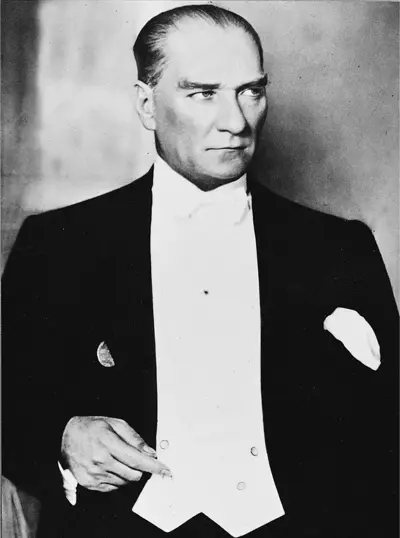
Kemal Atatürk was a Turkish field marshal, revolutionary statesman, author, and the founding father of the Republic of Turkey, serving as its first president from 1923 until his death in 1938. He undertook sweeping progressive reforms, which modernized Turkey into a secular, industrial nation. Ideologically a secularist and nationalist, his policies and theories became known as Kemalism. Due to his military and political accomplishments, Atatürk is regarded as one of the most important political leaders of the 20th century.
