Mustafa Kemal Ataturk Quotes
The Turkish army will have done its duty when it defends the country from foreign aggression and frees the nation from fanaticism and intellectual slavery. The Turkish nation has fallen far behind the West. The main aim should be to lead it to modern civilization.
Kemal Ataturk, 1881-1938, 1st President and founder of the Turkish Republic, A statement to a German officer, ~1912, Quoted in Andrew Mango, Ataturk
Sourced by: Eigen's Political and Historical Quotations

At the time, Muslim clerics had a great deal of influence and in many cases legal control over all facets of Turkish society much as exists in other Islamic societies today. They even controlled what was taught in the schools. Remarkably, without bloodshed, Ataturk broke both the power and the influence of the clerics on all official and public activities. Many Turkish Muslims even developed a type of reformed Islam with the relationship between the individual and the clerics one of parity much like Protestant churches in the West. At the same time there was a more orthodox part of the population and while they sent their children to religious schools, they also attended public schools so even the orthodox Muslims in Turkey learned science and modern subjects which are still not taught in most Islamic schools and madrassas.
This was a radical speech for the time, suggesting reforms that had been unthinkable to most Turks. Although it is not prohibited by the Koran and early Islamic artists made some of the greatest paintings and depictions of people, fundamentalists gained control of Islam and interpreted any statue as an idol that could be worshipped and this generalized to Islamic art in general where people ceased to be depicted and even animal depictions were rare. Muslim art developed incredible geometric intricacy but tended not to depict anything that is real. This extended to photography and illustrations in books including textbooks. At the same time, not unlike some Christian and Jewish Fundamentalists, the Muslim fundamentalists opposed science and the teaching thereof on the grounds that all authentic knowledge was in the Koran and anything else was not only false but also heretical. So this speech was a type of “declaration of war” against the established religious order and culture.

Turkey had become a modern, secular nation under the leadership of Ataturk. At the time of this interview, a religious party had won a plurality of seats in the Parliament and while not rolling back the secular nature of the Turkish state which is enshrined in the Turkish Constitution, has tried to stem the tide of secularism.

The Jews and Arabs for years shared Palestine. But the Jews spread out over the world, becoming modern and Westernized in the process. When the Jews returned to Palestine as a part of the Zionist movement, they were more modern, Westernized, and culturally at odds with their old Arab cousins, whose cultures had atrophied. The Arabs resented the Westernized culture that was being introduced into the Middle East. One point of view is that had Israel not tried to introduce moderism and Western ideas into the Middle East, the Jewish State might have been more accepted. However, not only did they bring a foreign perspective (democracy), education and techmology and capitalism to the area, but they far outpassed the Arab nations in agriculture, industry, science, medicine and general standard of living. The Arab dictators and monarchs had always had the excuse for poverty that the land was so poor that it simply could not be developed, but Israel developed the worst of the land in the area with no oil or natural resources. Every day of Israeli prosperity and scientific achievement was an embarassment for the rest of the Middle East where even the rich oil countries were not improving the lot of the average citizen.
Ataturk was one of the few revolutionary leaders who appreciated the importance of maintaining a Republic over time and allowed for the possibility that the revolutionary government might become corrupt. So like Thomas Jefferson, he always told citizens to be ever vigilant. In the case of Turkey, on several occasions fundamentalist religious forces have attempted to regain control of the secular republic and the government and mindful of Ataturk’s warnings the Army and other forces have rallied to keep Turkey independent and secular.

This quotation illustrated the extreme polarization between the current fundamentalist Muslims, and the Muslim modernists and the West. Kamal Ataturk, the great leader and stateman who is the father of modern Turkey, is castigated by the author for leading the new Turkish parliament to depose the Caliph – the civil and religious autocrat, one of whom reigned from after the death of Muhammad till his abolishment in 1924. Most of the rest of the world credits Ataturk with being one of the great leaders of all time—one who led a democratic revolution which transformed Turkey into the only Muslim secular democracy, requiring pubic secular European type education for all children, giving women the right to vote (before the U. S. even), adopting a European alphabet and dress, and outlook on life—creating most remarkably a total cultural revolution with virtually no loss of life. No revolutionary leader, before or since has led so extensive a political and cultural revolution, and it was a bloodless revolution. Turkey, into the 21st century, was by far the most powerful, industrialized, scientific and modern nation of Muslims in the world and others were far behind. Yet many Islamic theologian still castigate Atatork for his great achievements as being against the will of God.
Ataturk as part of his radical reforms elevated secular teachers to a very high social status and moved science and engineering into the curriculum over the objections of traditionalists and Islamic fundamentalists, and he did this in an overwhelmingly Muslim country.

The palace, which had belonged to the Ottoman Caliphs, who were called “Shadows of Allah on Earth”.
This is a very Jeffersonian type statement.


After Turkey’s defeat in WWI, some Turkish leaders like Riza Nur wanted Turkey to become a colony of America. This they believed would hasten Turkey’s development and modernization.


The People’s Party that Ataturk formed is the oldest political party in Turkey.
Ataturk had been a military hero, but was very much opposed to war and military adventurism not unlike the Dwight Eisenhower and Colin Powell type leaders. However, the one thing that he thought worth the sacrifice of his own and other Turkish lives was Turkish independence and sovereignty. Historically, the Ottoman Empire which Ataturk finally ended, had dominated half of Europe and all of the Mid East at the cost of sovereignty of other nations and Ataturk saw no more important virtue with dying for than national sovereignty. See {125322} and {584501}.
Public money had traditionally been spent to support shrines of Muslim saints. Ataturk ended such subsidies.
Ataturk wanted to change the Turkish alphabet from Arabic to Latin characters. Experts estimated that it would take at least 15 years. Ataturk allowed no parallel usage, made it illegal for any documents or signs to be written in Arabic, and it was done in 3 months. The benefit was that Arabic took much longer to learn. Relatively few people could read or write. Arabic had been imposed on the Turkish language. Printing with movable type was much more difficult in Arabic and Atatuk wanted many more books published and read. Soon Turkey had the highest literacy rate in the Islamic world, and rivaled that of most Western nations. Making the sudden change not only had the advantage of fixating the entire society on the change, but did not allow opponents of the change (of which there were many) —especially the Islamic clergy many of whom felt that the Koran was the only book that people should be allowed to read.
In 1925 his administration had passed a law banning the wearing of the traditional Muslim hat.
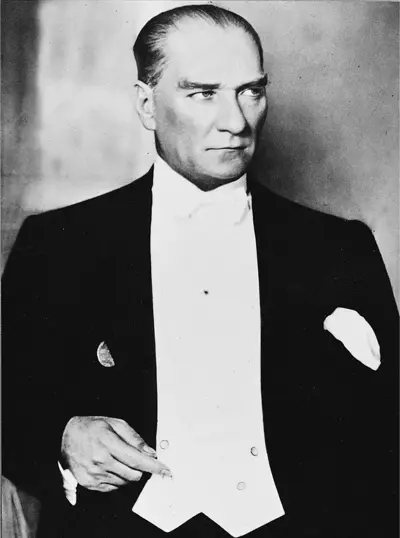
Kemal Atatürk was a Turkish field marshal, revolutionary statesman, author, and the founding father of the Republic of Turkey, serving as its first president from 1923 until his death in 1938. He undertook sweeping progressive reforms, which modernized Turkey into a secular, industrial nation. Ideologically a secularist and nationalist, his policies and theories became known as Kemalism. Due to his military and political accomplishments, Atatürk is regarded as one of the most important political leaders of the 20th century.
