Mustafa Kemal Ataturk Quotes
Today the Turkish nation is called on to defend its capacity for civilization, its right to life and independence – its entire future.
Kemal Ataturk, 1881-1938, 1st President and founder of the Turkish Republic, A proclamation terminating the Ottoman Empire and establishing the Turkish Republic, 1923, Quoted in Andrew Mango, Ataturk
Sourced by: Eigen's Political and Historical Quotations


The Ottoman Turks, at war with Russia, exterminated a large proportion of the Armenian population of the then Turkish Empire. Some of the ethnic Armenians were working with Armenians in greater Russia and thus were a risk to the Turks. However, they starved, shot, beat, hung, and bayoneted hundreds of thousands of ethnic Armenians, wiping out entire villages and towns. Despite the fact that women and little children were all killed, Modern Turkey even into the 21st century refused to admit that this was a genocide even though there was ample documentation to prove it was not spontaneous but government ordered by the “Young Turks” then controlling Turkey. See {620603} and {612638} for examples. The modern Turks maintain the view expressed during the genocide that Armenians were a threat to Turkish Independence.


Turkey under the Ottomans had been an imperialist, expansionist, empire, fighting and ruling over half of Europe and all of the Middle East. Ataturk argued that fighting and taking casualties should only take place to protect the nation’s independence and not to build or maintain an empire.


Mobutu with Amerucan CIA and French assistance deposed Lumumba, murdered him, and seized power.

This newspaper was an English language organ published by General Allenby’s British and Allied forces in the Middle East. Prior to the war, the Middle East was all part of the Ottoman Empire. However, the Ottoman Turks sided with Germany in WWI and their Middle East dominions were targets for the allied military strategy.


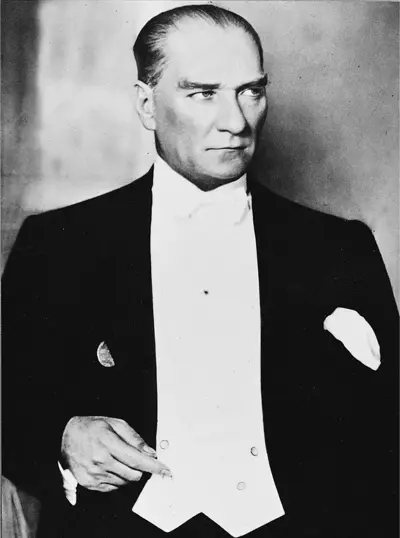
Kemal Atatürk was a Turkish field marshal, revolutionary statesman, author, and the founding father of the Republic of Turkey, serving as its first president from 1923 until his death in 1938. He undertook sweeping progressive reforms, which modernized Turkey into a secular, industrial nation. Ideologically a secularist and nationalist, his policies and theories became known as Kemalism. Due to his military and political accomplishments, Atatürk is regarded as one of the most important political leaders of the 20th century.
