Mustafa Kemal Ataturk Quotes
The change to the Latin alphabet will be done in three months or not at all.
Ataturk wanted to change the Turkish alphabet from Arabic to Latin characters. Experts estimated that it would take at least 15 years. Ataturk allowed no parallel usage, made it illegal for any documents or signs to be written in Arabic, and it was done in 3 months. The benefit was that Arabic took much longer to learn. Relatively few people could read or write. Arabic had been imposed on the Turkish language. Printing with movable type was much more difficult in Arabic and Atatuk wanted many more books published and read. Soon Turkey had the highest literacy rate in the Islamic world, and rivaled that of most Western nations. Making the sudden change not only had the advantage of fixating the entire society on the change, but did not allow opponents of the change (of which there were many) —especially the Islamic clergy many of whom felt that the Koran was the only book that people should be allowed to read.
Kemal Ataturk, 1881-1938, 1st President and founder of the Turkish Republic, A statement to his language reform commission, 1928, Quoted in Andrew Mango, Ataturk
Sourced by: Eigen's Political and Historical Quotations

This was a radical speech for the time, suggesting reforms that had been unthinkable to most Turks. Although it is not prohibited by the Koran and early Islamic artists made some of the greatest paintings and depictions of people, fundamentalists gained control of Islam and interpreted any statue as an idol that could be worshipped and this generalized to Islamic art in general where people ceased to be depicted and even animal depictions were rare. Muslim art developed incredible geometric intricacy but tended not to depict anything that is real. This extended to photography and illustrations in books including textbooks. At the same time, not unlike some Christian and Jewish Fundamentalists, the Muslim fundamentalists opposed science and the teaching thereof on the grounds that all authentic knowledge was in the Koran and anything else was not only false but also heretical. So this speech was a type of “declaration of war” against the established religious order and culture.
At the time, Muslim clerics had a great deal of influence and in many cases legal control over all facets of Turkish society much as exists in other Islamic societies today. They even controlled what was taught in the schools. Remarkably, without bloodshed, Ataturk broke both the power and the influence of the clerics on all official and public activities. Many Turkish Muslims even developed a type of reformed Islam with the relationship between the individual and the clerics one of parity much like Protestant churches in the West. At the same time there was a more orthodox part of the population and while they sent their children to religious schools, they also attended public schools so even the orthodox Muslims in Turkey learned science and modern subjects which are still not taught in most Islamic schools and madrassas.

In 1925 his administration had passed a law banning the wearing of the traditional Muslim hat.


1st Earl of Beaconsfield


One of Ferguson’s theses is that historical change often happens very rapidly.


Zhou, more than any other Chinese official, was responsible for the dramatic change in the Chinese economic shift from a classical socialist model to a modern market driven competitive economy.
Ataturk quickly envisioned the importance of the airplane. He even sent is daughter to Russia to learn to fly a plane, and she became the first Turkish Military Officer to do so. This was typical of Ataturk—killing two or more reform “birds” with one stone. He not only brought the airplane into the Turkish consciousness by having his daughter fly which attracted great attention of the press and got people talking, but showed that women were capable of the most complex technological tasks. Before Ataturk, few women in Turkey ever did anything but parenting and homemaking. Ataturk gave Turkish women the vote before America adopted women’s suffrage.

While this type of modernization had been a theme of her reign, it was particularly fascinating at this time when China had been invaded by Japan and 7 Western Countries, she still argued that the only way for China to thrive and attain true independence was to reform and adopt many Western Ways. Chinese leader after her gave lip service to doing this but never wanted to implement the reforms lest the lose power. Ironically, it was under Communist leader Deng Xiaoping, 1904-1993, that Cixi’s notion of adopting modern Western economic and technological models and approaches was finally implemented and then China made the greatest improvement of any large society ever in a relatively short term. However, Deng stopped short of adopting Western notions of political freedom.

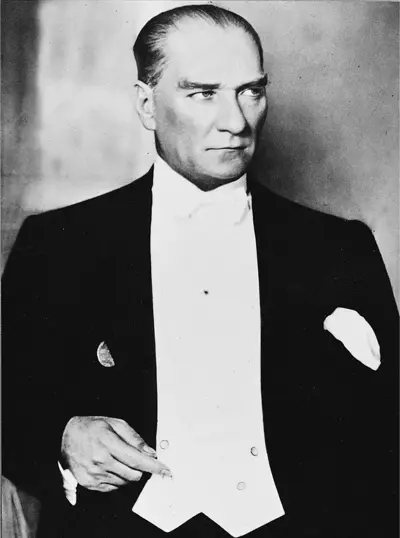
Kemal Atatürk was a Turkish field marshal, revolutionary statesman, author, and the founding father of the Republic of Turkey, serving as its first president from 1923 until his death in 1938. He undertook sweeping progressive reforms, which modernized Turkey into a secular, industrial nation. Ideologically a secularist and nationalist, his policies and theories became known as Kemalism. Due to his military and political accomplishments, Atatürk is regarded as one of the most important political leaders of the 20th century.
