Mustafa Kemal Ataturk Quotes
The people of the Turkish republic, who claim to be civilized must prove that they are civilized by the way they appear. And that, means boots and shoes, trousers, shirt, and tie, jacket and vest. And to complete these, a cover with a brim on our heads. I want to make this clear. This head covering is called a hat
In 1925 his administration had passed a law banning the wearing of the traditional Muslim hat. See {593676} for his reasoning.
Kemal Ataturk, 1881-1938, 1st President and founder of the Turkish Republic, Address to the people of Inebolu, 1925
Sourced by: Eigen's Political and Historical Quotations

He was describing the wife of the Turkish leader, Kemal Ataturk. Turkey at the time was a traditional Muslim culture where women wore burkas and very traditional Islamic female dress. Ataturk was a great reformer who placed great emphasis on reforming traditional customs of dress when supported and/or mandated by clerics. He used himself and his family as exemplars. At this particular occasion she appeared in a state ceremony wearing riding jodhpurs—pants—with leather boots and a silk blouse with no head covering. It was shocking to see an important woman in a silk blouse but absolutely astounding to see her in what was then perceived as men’s attire. Ataturk went on to completely change the nature of dress in Turkey—especially lifting the restrictions on women. See {593676}, {584524} and {610605}.

In 1925 his administration had passed a law banning the wearing of the traditional Muslim hat.

At the time, headwear identified the wearer’s caste and class. Fezes, Turbans, etc. were eliminated in favor of hats. This was Ataurk’s solution to two problems: He wanted to have Turkey modernize and develop along the lines of Western democracy and the traditional Islamic headgear being replaced by Western hats were daily symbols of the national modernization. The second advantage was that Turks could no longer identify caste and class by the traditional headgear and the society became much more egalitarian which it has been ever since.
He insisted that Turks wear hats rather than the class-specific traditional headwear. Some Turks preferred the word “modernized” to “civilized.”
At the time, Muslim clerics had a great deal of influence and in many cases legal control over all facets of Turkish society much as exists in other Islamic societies today. They even controlled what was taught in the schools. Remarkably, without bloodshed, Ataturk broke both the power and the influence of the clerics on all official and public activities. Many Turkish Muslims even developed a type of reformed Islam with the relationship between the individual and the clerics one of parity much like Protestant churches in the West. At the same time there was a more orthodox part of the population and while they sent their children to religious schools, they also attended public schools so even the orthodox Muslims in Turkey learned science and modern subjects which are still not taught in most Islamic schools and madrassas.


Ataturk wanted to change the Turkish alphabet from Arabic to Latin characters. Experts estimated that it would take at least 15 years. Ataturk allowed no parallel usage, made it illegal for any documents or signs to be written in Arabic, and it was done in 3 months. The benefit was that Arabic took much longer to learn. Relatively few people could read or write. Arabic had been imposed on the Turkish language. Printing with movable type was much more difficult in Arabic and Atatuk wanted many more books published and read. Soon Turkey had the highest literacy rate in the Islamic world, and rivaled that of most Western nations. Making the sudden change not only had the advantage of fixating the entire society on the change, but did not allow opponents of the change (of which there were many) —especially the Islamic clergy many of whom felt that the Koran was the only book that people should be allowed to read.

Over 200 years later Ataturk, the leader of Turkey, also mandated Western dress. The theory was that by adopting Western dress, other Western modernization would follow. Another benefit is that a populous sees visible change and is therefore more open to additional change and modernization. In the case of Turkey, there was a social hierarchy that was indicated by dress and requiring western dress eliminated these outward and visible signs of rank thus promoting equality. In Russia, it was an earlier time and Peter’s Russians were much more backward than the Turks of over 200 years later.

This quotation illustrated the extreme polarization between the current fundamentalist Muslims, and the Muslim modernists and the West. Kamal Ataturk, the great leader and stateman who is the father of modern Turkey, is castigated by the author for leading the new Turkish parliament to depose the Caliph – the civil and religious autocrat, one of whom reigned from after the death of Muhammad till his abolishment in 1924. Most of the rest of the world credits Ataturk with being one of the great leaders of all time—one who led a democratic revolution which transformed Turkey into the only Muslim secular democracy, requiring pubic secular European type education for all children, giving women the right to vote (before the U. S. even), adopting a European alphabet and dress, and outlook on life—creating most remarkably a total cultural revolution with virtually no loss of life. No revolutionary leader, before or since has led so extensive a political and cultural revolution, and it was a bloodless revolution. Turkey, into the 21st century, was by far the most powerful, industrialized, scientific and modern nation of Muslims in the world and others were far behind. Yet many Islamic theologian still castigate Atatork for his great achievements as being against the will of God.


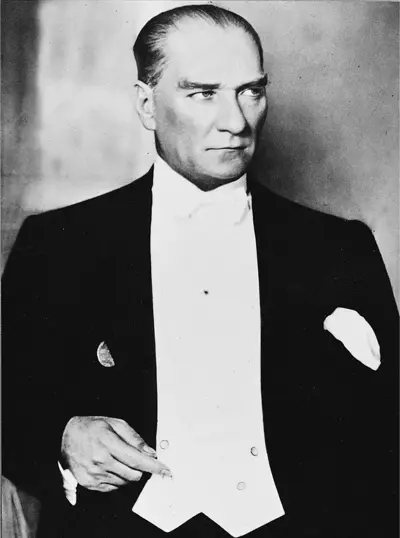
- Born: May 19, 1881
- Died: November 10, 1938
- Nationality: Turkish
- Profession: Leader
Kemal Atatürk was a Turkish field marshal, revolutionary statesman, author, and the founding father of the Republic of Turkey, serving as its first president from 1923 until his death in 1938. He undertook sweeping progressive reforms, which modernized Turkey into a secular, industrial nation. Ideologically a secularist and nationalist, his policies and theories became known as Kemalism. Due to his military and political accomplishments, Atatürk is regarded as one of the most important political leaders of the 20th century.
