Mustafa Kemal Ataturk Quotes
The evils which sapped the nation’s strength had all been wrought in the name of religion.
Kemal Ataturk, 1881-1938, 1st President and founder of the Turkish Republic, Quoted in Andrew Mango, Ataturk: The Biography of the Modern Turkey
Sourced by: Eigen's Political and Historical Quotations


The Torah comprises the first 5 books of the Bible (Old Testament). The Arab countries of the Middle East are not alone in having to content with ultra-religious clerics who want to control the government and use it to impose religious law on the entire population. Israel also has the problem. In the Arab countries to deny being religion is to put yourself in danger including risking your life. So no one really knows what proportion of the population supports the religious imposition from the government. In Israel, however, this is easily determined by polls. The majority of Israelis are secular Jews. Of the religious Jews, the majority of them believe in extensive separation between the state and the religion. But there is a minority of ultra-orthodox which would have Israel to be a Theocracy. They are a minority but they are politically very strong. They receive large financial support from extremely wealthy Americans, have religious political parties, are extremely passionate advocates, and are willing to devote huge amounts of time to make Israel a more religious state and ideally a theocracy. Ironically, there is a great religious and philosophical similarity between the extremist Jews of Israel and the extremists Muslims in many of the Arab nations. They both want a theocracy. The only difference is which religion should the Theocracy represent.


Toleration is a relative term. The Muslim Moors made Christians (and Jews) pay a special tax. At times they were forced to wear special clothing so that they could be readily identified. And they could not build churches larger or taller than the smallest mosque in the community. At times, their occupations were restricted but at other times Christians and Jews were appointed to the highest positions like Vizier. The Inquisition, in contrast, forced all Muslims (and Jews) to leave the country without any of their property or money or be tortured and killed—usually by burning at the stake unless of course that they converted to Christianity.
In one of the historical ironies of the 12th century, a Christian sect preferred the rule of the Muslims than their Christian brethren—on the grounds of religious tolerance. It illustrates the changes that take place over time. By the 21st century, it was the Christians who were thought of as tolerant and the Muslims as the opposite.


It is this verse that for some Muslims justifies terrorism against non-Muslims. See {584354} for a specific example. There are similar provisions in the Old Testament which a few extremely conservative Jews and Christians have used to advocate for blasphemy being a capital crime. Note that if an unbeliever repents and becomes a Muslim, he should be spared.


In 2005 Rose published a number of cartoons some of which depicted the Muslim Prophet, Muhammad which offended many fundamentalist Muslims who had a tradition who had a tradition of never depicting the visage of the Prophet. A delegation of clerics demanded an apology from Rose and the country of Denmark, claiming that they and Islam, like other religions, were entitled to respect.
Since Muslims try and convert others, one who changes religion and becomes a Muslim is exempt. The death penalty is reserved for Muslims who leave the religion.

While not in the Koran, this attributed statement is the basis for the ban on non-Muslims going on a Hajj and going to the most holy Muslim places—Mecca, Mina, Muzdalifa, and Arafat as well as the anti-religious hostility to all religions but Islam which is present in some Muslim countries.


Ingersoll was considered to be the greatest orator and political thinker of his day, but his overt atheistic views curtailed his elected political career.

While Perez describes the situation accurately, he does not mention here that there is a minority of fundamentalist Jewish Israelis, and they too do not make compromises easily. Nor do the Christian fundamentalists in the United States. All say, “How do you compromise with the will of God.”
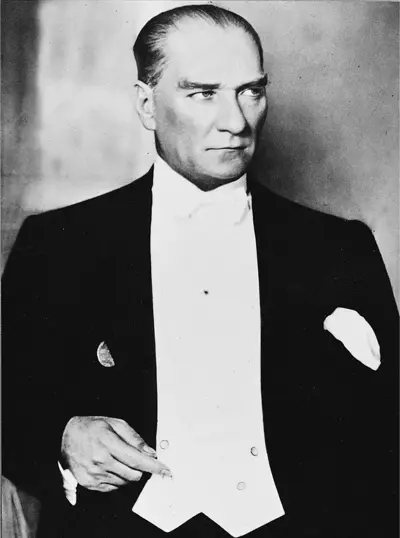
Kemal Atatürk was a Turkish field marshal, revolutionary statesman, author, and the founding father of the Republic of Turkey, serving as its first president from 1923 until his death in 1938. He undertook sweeping progressive reforms, which modernized Turkey into a secular, industrial nation. Ideologically a secularist and nationalist, his policies and theories became known as Kemalism. Due to his military and political accomplishments, Atatürk is regarded as one of the most important political leaders of the 20th century.
