Lucretius Quotes
To what great evils has religion been able to impel men.
Titus Lucretius Carus, 96 BC-55 BC, [Lucretius], Roman Philosopher, De Rerum Natura
Sourced by: Eigen's Political and Historical Quotations


The King, a religious exremist fanatic, was a great supporter of the Inquisition whose excesses were horrible during his reign.

The Torah comprises the first 5 books of the Bible (Old Testament). The Arab countries of the Middle East are not alone in having to content with ultra-religious clerics who want to control the government and use it to impose religious law on the entire population. Israel also has the problem. In the Arab countries to deny being religion is to put yourself in danger including risking your life. So no one really knows what proportion of the population supports the religious imposition from the government. In Israel, however, this is easily determined by polls. The majority of Israelis are secular Jews. Of the religious Jews, the majority of them believe in extensive separation between the state and the religion. But there is a minority of ultra-orthodox which would have Israel to be a Theocracy. They are a minority but they are politically very strong. They receive large financial support from extremely wealthy Americans, have religious political parties, are extremely passionate advocates, and are willing to devote huge amounts of time to make Israel a more religious state and ideally a theocracy. Ironically, there is a great religious and philosophical similarity between the extremist Jews of Israel and the extremists Muslims in many of the Arab nations. They both want a theocracy. The only difference is which religion should the Theocracy represent.

Most Muslims believe that Islam is a religion of peace. A small minority of fanatic extremists believe as Al-Buti does. They are the ones who are the most dangerous for all.

This statement is eerily similar to the statements of some of the Islamic fanatic fundamentalists 80 years later.


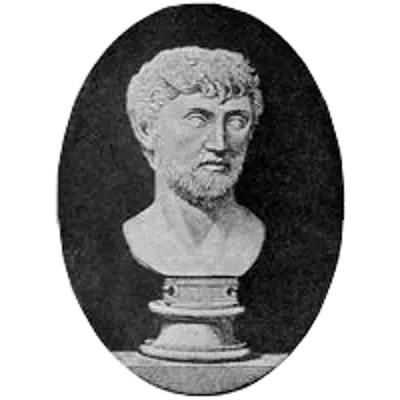
Titus Lucretius Carus (/ˈtaɪtəs luːˈkriːʃəs/ TY-təs loo-KREE-shəs, Latin: [ˈtɪtʊs lʊˈkreːtɪ.ʊs ˈkaːrʊs]; c. 99 – c. 55 BC) was a Roman poet and philosopher. His only known work is the philosophical poem De rerum natura, a didactic work about the tenets and philosophy of Epicureanism, and which usually is translated into English as On the Nature of Things. Lucretius has been credited with originating the concept of the three-age system that was formalised in 1836 by C. J. Thomsen.
