Mustafa Kemal Ataturk Quotes
It is claimed that religious unity is also a factor in the formation of nations. Whereas, we see the contrary in the Turkish nation. Turks were a great nation even before they adopted Islam. This religion did not help the Arabs, Iranians, Egyptians and others to unite with Turks to form a nation. Conversely, it weakened the Turks’ national relations; it numbed Turkish national feelings and enthusiasm. This was natural, because Mohammedanism was based on Arab nationalism above all nationalities.
Few non-Arab Muslims would publicly admit this historical truth, and at the time this view was shocking to the most religious men in Turkey. However it resonated with many of the average citizens. The entire Arab world had been subject to and controlled by Turkey, and amongst the Turks, the backward Arabs, were not very popular and were historically seen as underdeveloped colonial subjects.
Kemal Ataturk, 1881-1938, 1st President and founder of the Turkish Republic, Quoted in Yurttaslik Bilgileri, Yenigun Haber Ajansi
Sourced by: Eigen's Political and Historical Quotations

Ataturk wrote this manual personally. Religious Turks took violent offense to Ataturk’s proclamation that Turks were great without Islam.

The Ataturk reforms modernized Turkey and turned it into the most modern and democratic of the Islamic countries. However, there were always forces and populist governments that tried to erode the Ataturk reforms—especially secularism.

In the rest of the Islamic world, the call to prayer was said in Arabic regardless of the national language. This reform was castigated by throughout the Islamic world who wanted Arabic to be the only language for Muslim religious communications. This was not unlike the insistence that they Catholic Church had maintained that all scripture was read in Latin and would not allow Bibles or mass to be said in any other language.


At the time Turkey and the Ottoman Empire included Egypt and most of the Middle East, Chechnya, Georgia, Armenia, Usbekistan, Ajerbaijon, Greece, Albania, Serbia, Bosnia, Croatia and other countries.


He was arguing to reserve some states as Muslim states by designation. 7 years later he would insist on a separate homeland. India was partitioned and Pakistan and Bangladesh resulted but at a fearful cost of tens of millions of lives.
In one of the historical ironies of the 12th century, a Christian sect preferred the rule of the Muslims than their Christian brethren—on the grounds of religious tolerance. It illustrates the changes that take place over time. By the 21st century, it was the Christians who were thought of as tolerant and the Muslims as the opposite.


This notion of the country of the Turks encompassed half of Europe and all of the Mideast
This mode of national definition is characteristic of many nations of Europe as well.
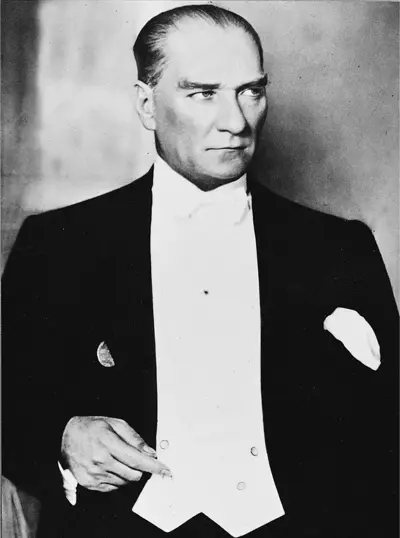
Kemal Atatürk was a Turkish field marshal, revolutionary statesman, author, and the founding father of the Republic of Turkey, serving as its first president from 1923 until his death in 1938. He undertook sweeping progressive reforms, which modernized Turkey into a secular, industrial nation. Ideologically a secularist and nationalist, his policies and theories became known as Kemalism. Due to his military and political accomplishments, Atatürk is regarded as one of the most important political leaders of the 20th century.
