Alexis de Tocqueville Quotes
I studied the Koran a great deal. I came away from that study with the conviction there have been few religions in the world as deadly to men as that of Muhammad. So far as I can see, it is the principal cause of the decadence so visible today in the Muslim world and, though less absurd than the polytheism of old, its social and political tendencies are in my opinion to be feared, and I therefore regard it as a form of decadence rather than a form of progress in relation to paganism itself.
This is another of De Tocqueville’s prescient statements that in retrospect seem so amazing given the time. This quotation could serve as an op ed in a newspaper of any of the industrial democracies of the early 21st century. However, he did not have the information of the details we have today that showed Islam as the pinnacle of scientific, philosophical, literary and medical achievement at the beginning of the second millennium, while the Christian nations of Europe were mired in the Dark Ages. It was the same Koran but a very different interpretation and framework that led to the decadence while it was the Protestant Reformation that triggered a Christianity that was hospitable to modernity and enlightenment.
Alexis de Tocqueville, 1805-1859, French Foreign Minister & Writer, Letter to Arthur de Gobineau, October 22, 1843
Sourced by: Eigen's Political and Historical Quotations

His views are a mix of modernism and fundamentalism. He favors democracy and elections but also favored the Taliban destroying the great ancient Buddha statues when he was called an idol worshipper for urging the preservation of art.


This is not terribly different however from Christians and Jews selectively quoting the Bible.


What makes this quotation very notable is the fact that Dr. El-Naggar is not even a cleric but a scientist. and yet in spite of his education, much broader than most Muslim men, he still thinks of the Koran as the only source of truth available to man. Observation, deduction, induction, experimentation all have no weight. Herein lies one basic difference between Islamic Fundamentalists on the one hand and Christian, Jewish, Hindu & Buddhist and other religion’s fundamentalists. All may accept their holy book as the revealed truth, but it is only the fundamentalist Muslim who believes that it is the ONLY source of truth and wisdom. A classic difference between the radical fundamentalist and the moderates is that moderates, like almost all religious people on earth, believe that there are other sources of knowledge, truth and wisdom besides their holy book.

Legal Religious Ruling. This is an example of a source of tension between some Muslims and others. Non-Muslims are required to have a Muslim Education in Muslim countries, but they insist that any required Christian or secular education in a non Muslim country is anti-Islamic.

She was born a Muslim herself and her life has been threatened by other, Muslims who are fundamentalists who are living proof or her point.
This phrase has been used by fundamentalists to justify forced conversion and the imposition of religious law—Sharia—on believers and unbelievers alike. The logic is that if God says believing orthodox Mosems are the best, that is what he wants for all. And therefore by forcing others to be orthodox and of the faith, one is doing God’s bidding. See Husain Haqqani, “Islam’s Medeval Outposts,” Foreign Policy November/December, 2002.
Theological & Legal Expert. The Sunnah, like the Koran, has statements of the Prophet, Mohammad. A fatwa is a religious legal ruling. This particular Fatwa shows the great difference between the Islamic State and a Republic or Democracy. In the latter forms, any religious practices must be consistent with the Constitution. Even though blasphemy might be prohibited by a religion, the United States Constitution for example protects anyone’s right to be blasphemous. In the Islamic system any constitution or law is subservient to and must be consistent with, the sayings of the Prophet Muhammad. In that sense, unless the Muslim populated nation is secular like Turkey, then the governments are partial or total theocracies.


She was explaining her antipathy to Muslim Fundamentalists having French citizenship or even sing allowed into the country.


Ironically, while Radical Fundamentalist Muslims abroad claim that Western materialism and dem0cracy is not only anti-Islamic but a danger to Islam, in America there has been a growing and thriving Islamic community which has had far less difficulty reconciling their religion and American democracy and values than have other religions such as the Amish and orthodox Jews. This ease of the transition and Islamic compatibility with modern America is perhaps the central reason for the hatred of America. Aslan argues that the Muslim reformation is succeeding very smoothly in America and is the model for Muslims throughout the world.
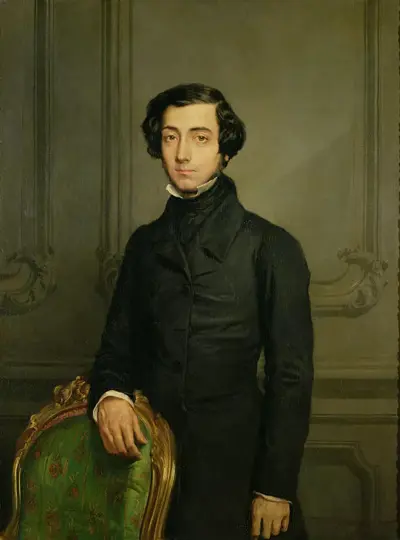
Alexis Charles Henri Clérel, comte de Tocqueville, colloquially known as Tocqueville (/ˈtɒkvɪl, ˈtoʊk-/), was a French aristocrat, diplomat, political scientist, political philosopher and historian. He is best known for his works Democracy in America (appearing in two volumes, 1835 and 1840) and The Old Regime and the Revolution (1856). In both, he analysed the improved living standards and social conditions of individuals as well as their relationship to the market and state in Western societies. Democracy in America was published after Tocqueville's travels in the United States and is today considered an early work of sociology and political science.
