Fareed Zakaria Quotes
The Koran is a vast, vague book, filled with poetry and contradictions (much like the Bible). You can find in it condemnations of war and incitements to struggle, beautiful expressions of tolerance and stern strictures against unbelievers. Quotations from it usually tell us more about the person who selected the passages than about Islam.
Fareed Zakaria, Editor, Foreign Affairs, Time & Newsweek International, Commentator and Host, The Global Public Square, The Common Review Vol. 4, No. 3, Winter 2006
Sourced by: Eigen's Political and Historical Quotations

This is not terribly different however from Christians and Jews selectively quoting the Bible.


This is another of De Tocqueville’s prescient statements that in retrospect seem so amazing given the time. This quotation could serve as an op ed in a newspaper of any of the industrial democracies of the early 21st century. However, he did not have the information of the details we have today that showed Islam as the pinnacle of scientific, philosophical, literary and medical achievement at the beginning of the second millennium, while the Christian nations of Europe were mired in the Dark Ages. It was the same Koran but a very different interpretation and framework that led to the decadence while it was the Protestant Reformation that triggered a Christianity that was hospitable to modernity and enlightenment.


This phrase has been used by fundamentalists to justify forced conversion and the imposition of religious law—Sharia—on believers and unbelievers alike. The logic is that if God says believing orthodox Mosems are the best, that is what he wants for all. And therefore by forcing others to be orthodox and of the faith, one is doing God’s bidding. See Husain Haqqani, “Islam’s Medeval Outposts,” Foreign Policy November/December, 2002.


Legal Religious Ruling. This is an example of a source of tension between some Muslims and others. Non-Muslims are required to have a Muslim Education in Muslim countries, but they insist that any required Christian or secular education in a non Muslim country is anti-Islamic.


In early Islam, scholarship and science was encouraged in all fields and in most areas the Muslims state of knowledge was greater than that of Christian Europe. However, over time the fundamentalists restricted the concept of knowledge to the Koran under the theory that anything worth knowing was in the Koran and that which was not should not be studied. In modern times Islamic nations, holding this very narrow view of education and learning, have intellectually stagnated—especially in modern science, technology, politics and philosophy. Most Islamic universities and madrasses teach only theological subjects and Koranic prescriptions of life and law and the few exceptions tend to be in strongly secular countries like Turkey.
Theological & Legal Expert. The Sunnah, like the Koran, has statements of the Prophet, Mohammad. A fatwa is a religious legal ruling. This particular Fatwa shows the great difference between the Islamic State and a Republic or Democracy. In the latter forms, any religious practices must be consistent with the Constitution. Even though blasphemy might be prohibited by a religion, the United States Constitution for example protects anyone’s right to be blasphemous. In the Islamic system any constitution or law is subservient to and must be consistent with, the sayings of the Prophet Muhammad. In that sense, unless the Muslim populated nation is secular like Turkey, then the governments are partial or total theocracies.


Gabriel exaggerates in the sense that while the quotation is correct for many Muslims, it is by no means true of all. Iran for example is an Islamic theocracy, but Turkey is a 99 percent Muslim nation which is totally secular and in some ways is much more restrictive of Islamic teaching and practice than most secular democracies. The fundamentalist Muslim view of the state and religion is essentially the same as the ultra orthodox Jews and Christians. It is true that a greater proportion of Muslims believe in the merging of civil and religious law than Jews and Christians, but by no means all. The non Arab Muslims are much less likely to see the unity of state and religion.
Oman was one of the first kingdoms to embrace Islam, albeit under the coercion described in this quotation.


They are so different that most people in the West think of what Khamenei describes as “religious democracy” as not even close to democracy—almost the antithesis of democracy, and Islamic fundamentalists perceive Western democracy as sinful and evil.


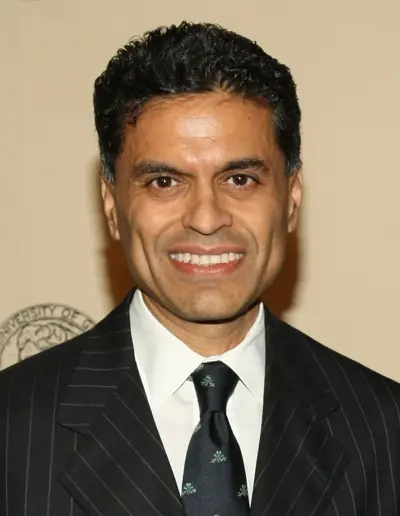
Fareed Rafiq Zakaria is an Indian-American journalist, political commentator, and author. He is the host of CNN's Fareed Zakaria GPS and writes a weekly paid column for The Washington Post. He has been a columnist for Newsweek, editor of Newsweek International, and an editor at large of Time.
