Akbar Ahmed Quotes
The word for knowledge appears in the Koran more often than any other except God.
Akbar Ahmed, Islamic Studies Scholar, C-SPAN Book TV, After Words, July 31, 2005
Sourced by: Eigen's Political and Historical Quotations


“Qur’an” is another way of spelling “Koran”. The belief in the perfection of the Koran is fairly common in Islamic nations. If Sharia is the civil law, as many Muslims insist that it is or should be, then there is no system of amendment and nothing that has occurred or has been learned since 800 AD that is any reason to improve or modify the law. Modern Islamic nations cope with this problem in one of three ways. The Fundamentalists take the Koran literally in all things and nothing is ever amended or modernized. Modernists will treat the Koran and Sharia as metaphorical and interpret it in the light of the modern world. More secular nations (like Turkey and Indonesia) reject Sharia as a civil legal system or as a source of inspiration of civil law.


Al-Maarri’s quotations are not only meaningful in their own right, but they illustrate the openness and free thinking that was allowed in the early days of Islam before about 1100. If anyone wrote such things today in most Islamic countries he would at least be jailed if not executed for blasphemy. And if any Christian in Europe made the same statement, he would have been excommunicated at least if not tortured and murdered.

Although a conservative, he had a great tolerance for and understanding of other points of view. For this some people thought him a radical.


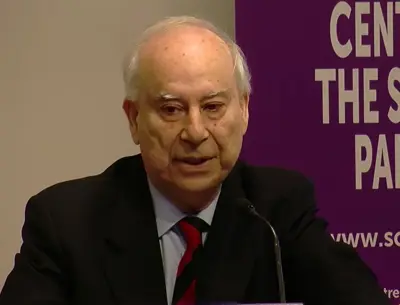
Akbar Salahuddin Ahmed, is a Pakistani-American academic, author, poet, playwright, filmmaker and former diplomat. He currently holds the Ibn Khaldun Chair of Islamic Studies and is Professor of International Relations at the American University in Washington, D.C. A former Pakistani High Commissioner to the UK and Ireland, Ahmed was a member of the Civil Service of Pakistan and served as Political Agent in South Waziristan Agency and Commissioner in Baluchistan. He also served as the Iqbal Fellow (Chair of Pakistan Studies) at the University of Cambridge as well as holding teaching positions at Harvard, Princeton, and the U.S. Naval Academy. An anthropologist and scholar of Islam, he received his PhD from the School of Oriental and African Studies in London. He has been called "the world's leading authority on contemporary Islam" by the BBC.
