ISAAC NEWTON
(Sir Isaac Newton)


Economics has never been a precise science which is one of the reasons it is called the “dismal science.” In the final analysis economics depends on the behavior of people—rational and irrational.
Frequently paraphrased as: “sometimes I feel as a child on the ocean shore picking up one pebble over another because it’s shinier. Yet, the great ocean of undiscovered truths lay before me.”
Many have extrapolated this physical notion to diplomatic, military, and political affairs.
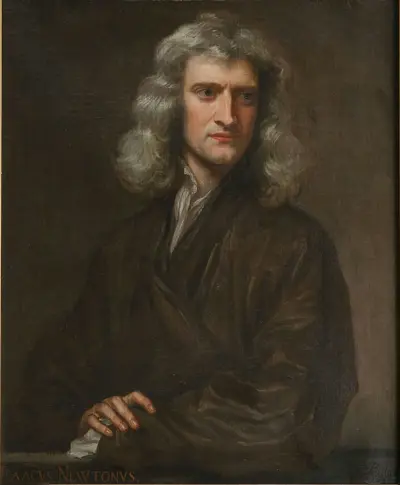
Sir Isaac Newton PRS was an English mathematician, physicist, astronomer, theologian, and author (described in his time as a "natural philosopher") who is widely recognised as one of the greatest mathematicians and most influential scientists of all time and as a key figure in the scientific revolution. His book Philosophiæ Naturalis Principia Mathematica (Mathematical Principles of Natural Philosophy), first published in 1687, established classical mechanics. Newton also made seminal contributions to optics, and shares credit with Gottfried Wilhelm Leibniz for developing the infinitesimal calculus.
