Adam Smith Quotes
The property which every man has in his own labour, as it is the original foundation of all other property, so it is the most sacred and inviolable. The patrimony of a poor man lies in the strength and dexterity of his hands, and to hinder him from employing this strength and dexterity in what manner he thinks proper, without injury to his neighbour, is a plain violation of this most sacred property.
Adam Smith, 1723-1790, Scottish Political Economist, Quoted in Arnold J. Toynbee, Lectures on the Industrial Revolution of the 18th Century in England
Sourced by: Eigen's Political and Historical Quotations


Internal population movement was tightly controlled in China for fear that the huge body of rural peasants would swamp the cities seeking economic opportunity. In 2000 the Chinese were debating the wisdom of this policy.


espoused in the Declaration of Independence


Ingersoll was considered to be the greatest orator and political thinker of his day, but his overt atheistic views curtailed his elected political career.

America’s first political economist


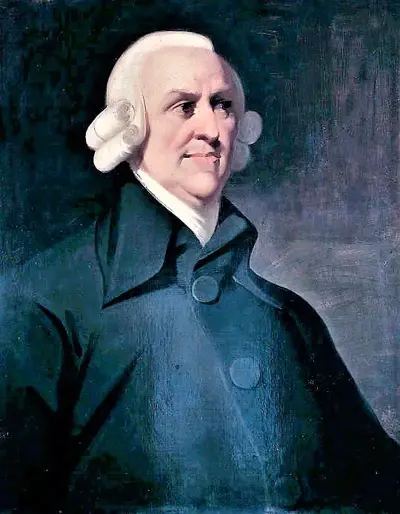
Adam Smith FRSA was a Scottish economist, philosopher as well as a moral philosopher, a pioneer of political economy, and a key figure during the Scottish Enlightenment, also known as ''The Father of Economics'' or ''The Father of Capitalism''. Smith wrote two classic works, The Theory of Moral Sentiments (1759) and An Inquiry into the Nature and Causes of the Wealth of Nations (1776). The latter, often abbreviated as The Wealth of Nations, is considered his magnum opus and the first modern work of economics. In his work, Adam Smith introduced his theory of absolute advantage.
