John Marshall Quotes
Individuals do not derive from government their right to contract, but bring that right with them into society.... every man retains the right to acquire property, to dispose of that property according to his own judgment, and to pledge himself for a future act.
John Marshall, 1755-1835, Chief Justice of the U. S. Supreme Court, U. S. Congressman (Federalist, VA), U. S. Secretary of War, U. S. Secretary of State, Ogden v. Saunders, 1827
Sourced by: Eigen's Political and Historical Quotations


See {587703} for a similar statement by a Supreme Court Justice.

espoused in the Declaration of Independence

She herself was an advocate for monogamy, but was opposed to the state or society interfering with anyone who chose differently. There was no position she advocated that was opposed and ridiculed more than this one. And her tying the Constitution to sexual freedom was itself considered not only whacky, but obscene and an insult to the Constitution and nation itself. The advocacy of the right of interracial marriage was as shocking as anything could be in those days. What would have surprised all those who derided her the most was that her sexual demands in toto became the law of the land and today, any government action to the contrary would shock and alarm most Americans.


This quotation has been used by gay rights advocates. Opponents argue that a gay lifestyle is not “innocent” in that it is Biblically prohibited. This brings the issue of separation of church and state into the argument.


The call for individual liberty and the right of personal property by clergy is surprising to many. This Cahier was the consensus of the Clergy of Blois in 1789. There were cahiers of several provinces of France—some by the clergy, some by the nobles. What is fascinating is the emergence of many of the pre-Revolutionary French concepts. The example of the American revolution and its principles was known throughout the educated classes of France.


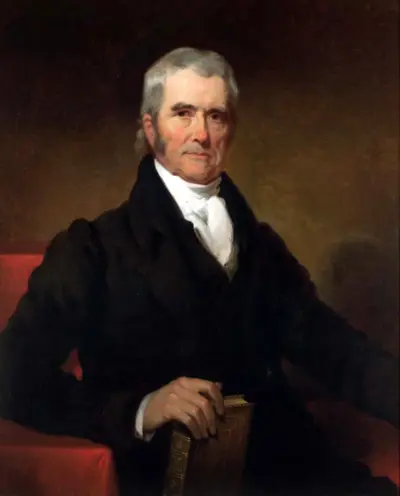
John Marshall was an American politician and lawyer who served as the fourth Chief Justice of the United States from 1801 to 1835. Marshall remains the longest-serving chief justice and fourth-longest serving justice in Supreme Court history, and he is widely regarded as one of the most influential justices to ever sit on the Supreme Court. Prior to joining the Supreme Court (and for one month simultaneous to his tenure as Chief Justice), Marshall served as the United States Secretary of State under President John Adams.
