The Masses Quotes
The Post Office was represented by Assistant District Attorney Barnes. He explained that the Department construed the Espionage Act as giving it power to exclude from the mails anything which might interfere with the successful conduct of the war.
The Justice Department shut the magazine down under the Espionage Act {612703} This censorship in hindsight was clearly unconstitutional, but this is yet another example of civil rights being eroded in wartime with timidity on the parts of the courts to uphold the constitution when the Executive is stating that the court ruling could greatly harm the nation. In retrospect, such testimony has almost always been fabricated lies or paranoid fears.
The Masses, Editorial, September 1917
Sourced by: Eigen's Political and Historical Quotations

Although it seems incredible to us today, thousands of people were arrested and prosecuted under the Espionage Act. The government particularly targeted leftists such as Eugene V. Debs, Bill Haywood, J. Philip Randolph, Victor Berger, John Reed, Max Eastman, and Emma Goldman. Debs was sentenced to 20 years in prison for criticizing the Act itself.


The Masses was a left wing publication which the then Post Office officials decided were “dangerous”. Later, the Supreme Court would hold that there could not be this degree of political censorship by Post Office officials.


Assigned to the Treasury Department to create war bond posters
America was entering the First World War as a combatant but there was considerable anti-war sentiment. The Wilson administration over-reacted and instituted many repressive laws and regulations. Leading Americans like Eugene Debs was jailed for several years simply for opposing the war and the military conscription that went with it. Our scientists were not allowed to receive German scientific journals which of course hurt us and not the Germans who read their research and ours.


The American Army had just liberated Bellau Wood, but had lost almost 8,000 men.

Note how the second paragraph nullifies the first of the government declares an emergency. This is a trick that is very common in constitutions.


In WWI Congress had passed a law that prohibited anyone from undermining or interfering with the war effort. The defendants had passed out anti-war literature to young men heading for military service. The court then overlooked the First Amendment and came up with a strange logic where the “clear and present danger” was the test of whether the First Amendment would apply. The anti war pamphleteers went to jail. Today, we look back on this and find it very surprising but this is yet another example of erosion of freedom and civil liberties when the nation is at war. By the 1950s, the Supreme Court had reversed itself and the First Amendment was restored to its original intent.

This had been a general, bipartisan principle from WWII through the Gulf War, but in the War on Terrorism, President George W. Bush and his administration deviated from the traditional American view and accused those who were criticizing their counter terrorism of aiding and abetting the enemy and attacked the loyalty and patriotism of their critics.

We were in the midst of WWI.

The Germans did not believe the British would send land troops. See {642105}.

This principle was incorporated into American law by the Supreme Court 1964 decision in Sullivan v. New York Times, where this argument drove the opinion.

Wikipedia: This was Debs's most famous speech. It was a socialist antiwar speech while the United States was at war, and it was used against him at his trial. Debs was convicted under the Espionage Law and sentenced to 10 years in prison. President Warren G. Harding commuted the sentence in 1921. The Espionage Act was so written that speaking against the war was defined as “Espionage”. This act and the Alien & Sedition Acts were the greatest infringements on Freedom of Speech in the History of the country and on both occasions, the Supreme Court chose not to get involved.

Virginia had adopted this right almost 20 years before it was added in the Bill of Rights to our Federal Constitution. Mason had drafted it.
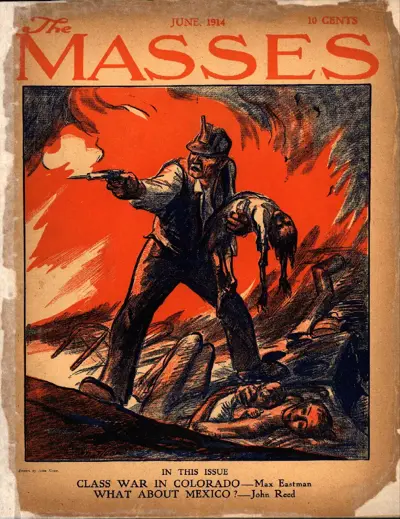
The Masses was a graphically innovative magazine of socialist politics published monthly in the United States from 1911 until 1917, when federal prosecutors brought charges against its editors for conspiring to obstruct conscription. It was succeeded by The Liberator and then later The New Masses. It published reportage, fiction, poetry and art by the leading radicals of the time such as Max Eastman, John Reed, Dorothy Day, and Floyd Dell.
