Daniel Webster Quotes
The people's government, made for the people, made by the people, and answerable to the people.
This quotation had a close proximity to Lincoln’s Gettysburg Address (see linked quote). Although this was probably Lincoln's most famous line, it was not totally original. John Adams came close in a 1774 proclamation (see linked quote). As did John Marshall in his McCulloch v. Maryland decision (see linked quote). There was also Thomas Cooper in 1795 (see linked quote). But the earliest close phrase use appears to be the English cleric, John Wycliffe, in 1382 (see linked quote). It is not known with which of these Lincoln was familiar.
Daniel Webster, 1782-1852, U. S. Congressman (Federalist, NH & MA), U. S. Senator (Federalist & Whig, MA), U. S. Secretary of State, Speech on Foot's Resolution, January 26, 1830
Sourced by: Eigen's Political and Historical Quotations

The government relationship to people phrase, although probably Lincoln's most famous, was not totally original. John Adams came close in a 1774 proclamation. As did John Marshall in his McCulloch v. Maryland decision. Daniel Webster's Speech on Foot's Resolution was very close. as was Theodore Parker in 1850 {629578}. There was also Thomas Cooper in 1795. But the earliest appears to be John Wycliffe in 1382 {567292}. It is not known with which of these Lincoln was familiar.

For that, the Church burned him at the stake. Note the phraseology and compare it to Gettysburg Address {458852}. It is not known whether Lincoln was aware of this quotation or others that used similar wording.

This appears to be the earliest use of the phrase Lincoln later made famous in the Gettysburg Address.

_0_thumbnail_47x47.jpg "Statue of Robert Hall in Leicester.")


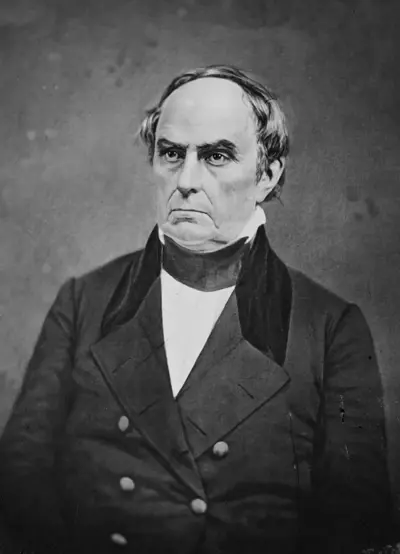
Daniel Webster was an American lawyer and statesman who represented New Hampshire and Massachusetts in the U.S. Congress and served as the U.S. Secretary of State under Presidents William Henry Harrison, John Tyler, and Millard Fillmore. As one of the most prominent American lawyers of the 19th century, he argued over 200 cases before the U.S. Supreme Court between 1814 and his death in 1852. During his life, he was a member of the Federalist Party, the National Republican Party, and the Whig Party.
