Alexander Hamilton Quotes
Here, sir, the people govern; here they act by their immediate representatives.
Hamilton, Alexander. "New York Ratifying Convention. Remarks, 17 June 1788." The Papers of Alexander Hamilton, edited by Harold C. Syrett, vol. 5, Columbia University Press, 1962, p. 36.


This quotation had a close proximity to Lincoln’s Gettysburg Address (see linked quote). Although this was probably Lincoln's most famous line, it was not totally original. John Adams came close in a 1774 proclamation (see linked quote). As did John Marshall in his McCulloch v. Maryland decision (see linked quote). There was also Thomas Cooper in 1795 (see linked quote). But the earliest close phrase use appears to be the English cleric, John Wycliffe, in 1382 (see linked quote). It is not known with which of these Lincoln was familiar.


See Franklin Delano Roosevelt and Grover Cleveland for a similar view.


The view was considered so radical at the time that Fox's name was erased from the Privy Council.


Note the similarity to Lincoln who Ataturk very much admired.

Garfield reminded Americans of how radical and unusual the concept of democracy had been at the time of the adoption of The Constitution, and that the American Revolution was one of ideas as well as armies.


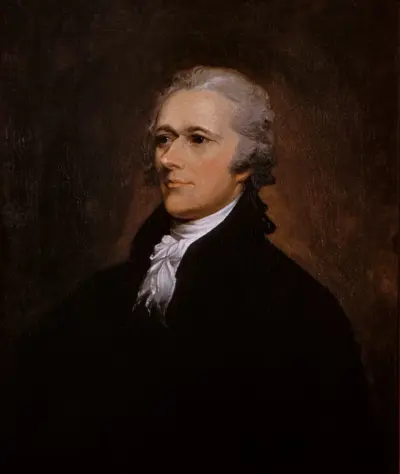
Alexander Hamilton was an American statesman, politician, legal scholar, military commander, lawyer, banker, and economist. He was one of the Founding Fathers of the United States. He was an influential interpreter and promoter of the U.S. Constitution, as well as the founder of the nation's financial system, the Federalist Party, the United States Coast Guard, and the New York Post newspaper. As the first secretary of the treasury, Hamilton was the main author of the economic policies of George Washington's administration. He took the lead in the federal government's funding of the states' debts, as well as establishing the nation's first two de facto central banks, the Bank of North America and the First Bank of the United States, a system of tariffs, and friendly trade relations with Britain. His vision included a strong central government led by a vigorous executive branch, a strong commercial economy, government-controlled banks, support for manufacturing, and a strong military.
