James A. Garfield Quotes
The colonists were struggling not only against the armies of a great nation, but against the settled opinions of mankind; for the world did not then believe that the supreme authority of government could be safely entrusted to the guardianship of the people themselves.
Garfield reminded Americans of how radical and unusual the concept of democracy had been at the time of the adoption of The Constitution, and that the American Revolution was one of ideas as well as armies.
James A. Garfield, 1831-1881, 20th President of the United States (Republican, OH), Inaugural Address, March 4, 1881
Sourced by: Eigen's Political and Historical Quotations


1st Viscount Milner


This quotation is historically important because Davis clearly states the reason for the rebellion of the South. The anti-slave states were growing at a greater rate than the slave states and despite the greater voting power that a southerner had (a result of the 3/5 count of slaves for census purposes, and the Senate), the handwriting was on the wall and the majority of the United States was against the vicious institution of slavery and would make it unprofitable, impossible and/or illegal in the coming years. Southern slavery advocates saw this as a “tyranny of the majority” and therefore took up arms. In the early 20th century, apologists for the Southern rebellion tried to promote the idea that there were reasons other than slavery, but this quotation and the resolutions of the states who withdrew from the Union make it clear that the right to maintain slavery was the only significant issue. In that sense it was a States’ Rights issue, but the South was opposed to States’ Rights when it came to States refusing to return fugitive slaves when Federal Law required such under the Dred Scott Supreme Court Decision.


During the early days of the American independence movement, many were preoccupied with the philosophical and theological issues of whether the Almighty approved of monarchy or not. Parker urged concentration on assuring independence first.


Darius argued for a monarchy and became king. . See {611015}

_0_thumbnail_47x47.jpg "Statue of Robert Hall in Leicester.")
For many people the implication of this quotation is that there should be no government secrets withheld from the citizens who have the right to examine. Others argue that government may have temporary secrets to protect against foreign enemies for example, but that these must be declassified very promptly so that the citizens can examine the actions of their government in time to replace the government if they are not satisfied. Almost all government officials tend to reject the first implication out of hand, and grudgingly accept the second with their discretion controlling when declassification should take place. The problem of America is twofold. There is much over-classification (material kept secret that should not be at all), and the time till declassification is long in general and truly absurd in many cases. For example, there are documents from WWII that by 2013 had still not been declassified. See {591444}, {641317}, and {589105} for exemplar views. William Jennings Bryan introduced this principle into the American political dialogue. See {641027}.


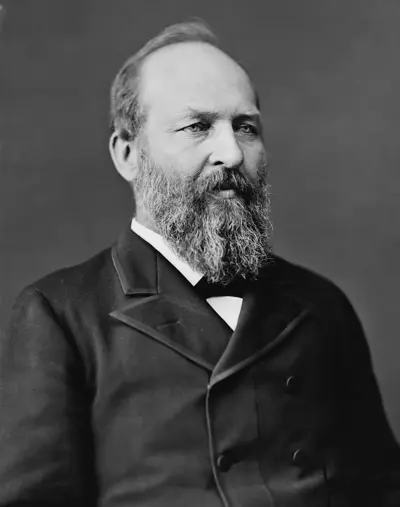
James Abram Garfield was the 20th president of the United States, serving from March to September 1881. Garfield was shot by an assassin four months into his presidency and died two months later. He is the only sitting member of the United States House of Representatives to be elected to the presidency.
