Caleb Cushing Quotes
Here, again, as I conceive, gentlemen forget that this government is a republican one, resting exclusively in the intelligence and virtue of the People.
Cushing, Caleb. Speech of Mr. Cushing, of Massachusetts, on the Right of Petition, as Connected with Petitions for the Abolition of Slavery and the Slave Trade in the District of Columbia: In the House of Representatives, January 25, 1836. Gales and Seaton, 1836, p. 4.


This quotation had a close proximity to Lincoln’s Gettysburg Address (see linked quote). Although this was probably Lincoln's most famous line, it was not totally original. John Adams came close in a 1774 proclamation (see linked quote). As did John Marshall in his McCulloch v. Maryland decision (see linked quote). There was also Thomas Cooper in 1795 (see linked quote). But the earliest close phrase use appears to be the English cleric, John Wycliffe, in 1382 (see linked quote). It is not known with which of these Lincoln was familiar.


The view was considered so radical at the time that Fox's name was erased from the Privy Council.

_0_thumbnail_47x47.jpg "Statue of Robert Hall in Leicester.")
For many people the implication of this quotation is that there should be no government secrets withheld from the citizens who have the right to examine. Others argue that government may have temporary secrets to protect against foreign enemies for example, but that these must be declassified very promptly so that the citizens can examine the actions of their government in time to replace the government if they are not satisfied. Almost all government officials tend to reject the first implication out of hand, and grudgingly accept the second with their discretion controlling when declassification should take place. The problem of America is twofold. There is much over-classification (material kept secret that should not be at all), and the time till declassification is long in general and truly absurd in many cases. For example, there are documents from WWII that by 2013 had still not been declassified. See {591444}, {641317}, and {589105} for exemplar views. William Jennings Bryan introduced this principle into the American political dialogue. See {641027}.


Originally it was published in Boston under the name “A Columbian Patriot.” The “principles to which she referred were the principles set out in our Constitution of 1787.


Chief legal officer of a Dutch town. He wanted to have a plebiscite in each town on major issues before the assembly so as to instruct the representative as to how to vote. The graphic is a painting of Adriaan van Zeebergh and his board of the Teylers Stichting.


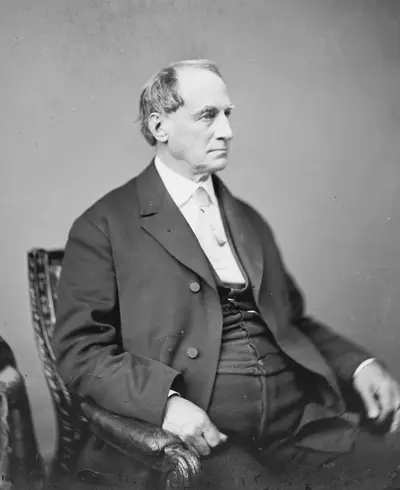
Caleb Cushing was an American Democratic politician and diplomat who served as a Congressman from Massachusetts and Attorney General under President Franklin Pierce. He was an eager proponent of territorial and commercial expansion, especially regarding the acquisition of Texas, Oregon and Cuba. He believed that enlarging the American sphere would fulfill "the great destiny reserved for this exemplar American Republic." Cushing secured the first American treaty with China, the Treaty of Wangxia of 1844; it gave American merchants trading rights in five Chinese ports. After the Civil War, Cushing negotiated a treaty with Colombia to give the United States a right-of-way for a trans-oceanic Canal. He helped obtain a favorable settlement of the Alabama Claims, and as the ambassador to Spain in 1870s defused the troublesome Virginius Affair.
