Mao Zedong Quotes
The Long March is the first of its kind in the annals of history, that it is a manifesto, a propaganda force, a seeding-machine. Has history ever witnessed a long march such as ours? For twelve months we were under daily reconnaissance and bombing from the skies by scores of planes, while on land we were encircled and pursued, obstructed and intercepted by a huge force of several hundred thousand men, and we encountered untold difficulties and dangers on the way; yet by using our two legs we swept across a distance of more than twenty thousand li through the length and breadth of eleven provinces. Let us ask, has history ever known a long march to equal ours? No, never. The Long March is a manifesto. It has proclaimed to the world that the Red Army is an army of heroes, while the imperialists and their running dogs, Chiang Kai-shek and his like, are impotent. It has proclaimed their utter failure to encircle, pursue, obstruct and intercept us. The Long March is also a propaganda force. It has announced to some 200 million people in eleven provinces that the road of the Red Army is their only road to liberation.
Chaing Kai Chek seemed to have the Red Army on the run with far more guns, planes & men. However while Chaing thought he was chasing the Communists, the Red Army traveled through 11 major Chinese provinces, helping the peasants to harvest their crops, build their homes, care for their sick & get indoctrinated in Communist political philosophy. In comparison, the Chaing forces abused the peasants, corruptly stole from them & brought no improvement in their living standard, sense of hope or fairness. Massive retreat became massive victory as so much of China had a Chance to compare the communists with the Kuomintang & unfortunately chose communism as Chaing and the Kuomingtang was such a poor example of capitalism-corrupt, ineffectual and heartless. At the same time, Mao and the other communist leaders were brilliant in their use of the retreating army to improve the lot of the peasants and left their biggest supporters as they were driven to the next province and repeated the process.
Mao Tse-Tung, 1893-1976, Chairman, Communist Party, China, On Tactics Against Japanese Imperialism, December 27, 1935
Sourced by: Eigen's Political and Historical Quotations

The non-communist forces of China were always struggling with each other for power. Attempts by non-communist reformers were defeated by autocrats, warlords, major landlords, and various religions organizations and denominations which were all fighting each other.
The Kuomintang was the anti-Communist political party controlled by Chaing Kai Chek and the major opponent of the Communists. It took more than another decade but Mau and the Communists with the vast support of the majority of the masses, did indeed take over all of China. At the time few thought that they would ever do it.


In 1927 there was a Peasant Uprising in the Hunan Province of China. Young Mau went there and wrote a report. Mao and other young communist leaders had a much more acute appreciation of sloganeering than their older revolutionary comrades. Even into the 3rd millennium, the same “Down with Imperialism” slogan could be heard in many part of the world, long after the Soviet Union collapsed and China and become capitalistic.

Giro'n is the Cuban name for the Bay of Pigs.

He drove the British into the sea when no one expected that outcome.

An example of this was the landing in the beaches of Normandy in WWII. Once on the beaches the allied troops had to win or die. Some of the most heroic fighting in American and English military history occurred on those beaches. Another was the Spanish Explorer Hernando Cortez who after landing in the New World, had his ships burned so that he and his soldiers had to conquer or they would die.


Every major Western power and Japan were looking to control parts of China for their own mercantile advantage. The Emperor, her adopted son, had stated that under no circumstances would the Chinese fight, but Cixi issued this decree, in effect, overruling the Emperor—a remarkable occurrence.

The Germans had invaded much of Russia, and this was a month before Pearl Harbor so the Russians had no idea that the United States would actively enter the war although they were getting war material help from America.


The critic observed that the South would not give up their slaves voluntarily and that and that vigorous abolition pressure on the South would lead to war and asked Angelina if she would want a civil war. Grimke’s response was predictive of what happened—the most terrible was in U. S. History to end the most terrible cruelty and persecution in American history. Note that she herself was willing to die to end slavery. See {629094}.

Like many war leaders, Davis tried to dehumanize the Northerners, against whom the Confederates were fighting. His “”theory” was that The Southerners were the good and upright sons of the Founding Fathers but the Northerners were the “degenerate” sons.
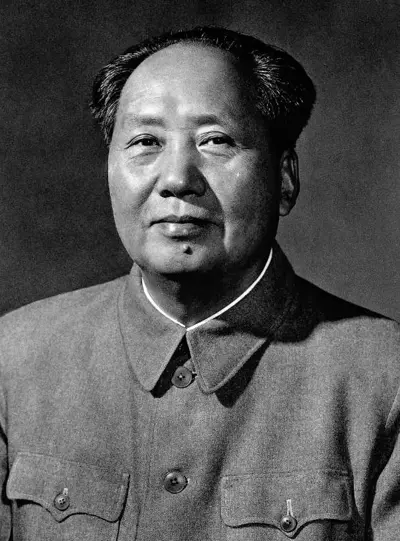
Mao Zedong, also known as Chairman Mao, was a Chinese communist revolutionary who was the founder of the People's Republic of China (PRC), which he ruled as the chairman of the Chinese Communist Party from its establishment in 1949 until his death in 1976. Ideologically a Marxist–Leninist, his theories, military strategies, and political policies are collectively known as Maoism.
